
PHYSICS · ELECTRICITY · INVENTION
Nikola Tesla
The Man Who Made Electricity Spin
He designed motors and power systems that still run the world, then watched his biggest dreams run out of money.
- 1856 to 1943
- Croatia and the United States
- Physics
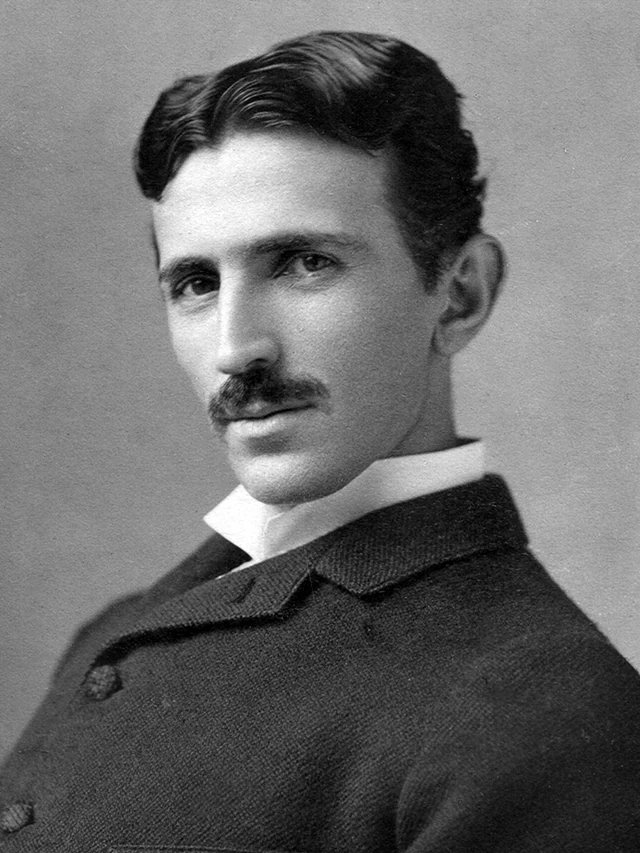

A life of discovery
The question they chased
Nikola Tesla was born in 1856 in the village of Smiljan, then part of the Austrian Empire and now in Croatia. His father was an Orthodox priest. Nikola studied engineering at the technical college in Graz from 1875, but he left in December 1878 without a degree. The question that pulled him was simple and hard. How could electricity turn a motor smoothly and reliably, without sparking parts that wear out?
He came to New York in June 1884 and worked for Thomas Edison for about six months. Then he left to work on his own. In 1888 he patented an alternating current induction motor. George Westinghouse bought his patents that year. Westinghouse used Tesla's patents to light the 1893 world's fair in Chicago and later to build the generators at Niagara Falls. Tesla said he first imagined the idea in 1882. That date is his own claim, not a documented one.
The big ideas
What Nikola figured out
In alternating current the flow of electricity switches direction many times each second. Its great strength is that a device called a transformer can raise the voltage to send power far with little loss, then lower it again to be safe in your home. Tesla was one of the inventors who made this practical. It is why power plants can be far from the cities they serve.
Tesla set several coils of wire around a rotor and fed them current in turn. Each coil's magnet reached its peak just after the one before it. The magnetic field seemed to spin, and it dragged the rotor along with it. The induction motor has no brushes to wear out, and this kind of motor is still found in factories and homes.
In 1891 Tesla built a coil that turns ordinary electricity into very high voltages at high frequency. It works by resonance, the same way a push at the right moment makes a swing go higher. Tesla coils are used in demonstrations and in some radio equipment. Tesla also hoped to send power through the air and the Earth. His plan to send useful power around the world that way never worked. He was wrong that the whole Earth could carry electrical energy for use anywhere.
Key moments
How it unfolded
- 1884He arrives in New York and goes to work for Edison.
- 1888His induction motor is patented and Westinghouse buys the rights to his alternating current system.
- 1891He becomes a United States citizen and builds his first Tesla coil.
- 1895A fire destroys his New York laboratory, with many of his notes and models.
- 1901J. P. Morgan gives him 150,000 dollars to build a wireless tower at Wardenclyffe on Long Island.
- 1943He dies in New York at the age of 86.
The person behind the science
The man behind the lightning
Tesla's life had big peaks and long, hard stretches. Around 1886 he dug ditches for 2 dollars a day. In 1895 a fire destroyed his laboratory. The Wardenclyffe tower, the project he cared about most, stalled in 1905 and was never finished. He was left with debts. He lived in a series of hotels and was evicted from one in 1923 over unpaid bills.
He had people on his side, though. He became close friends with the writer Mark Twain and with Robert Underwood Johnson, an editor. Westinghouse had paid him for his patents, and in 1891 Tesla agreed to give up his royalties to help the company. From 1934 Westinghouse paid him 125 dollars a month, and he lived at the Hotel New Yorker for the rest of his life. He never married. He became fond of pigeons and fed them every day.
Small things that make them human
- A friend named TwainMark Twain called Tesla's motor patent the most valuable since the telephone.
- A very expensive pigeonHe spent more than 2,000 dollars caring for one injured white pigeon.
- Habits and numbersHe counted his steps, and by many accounts he liked numbers divisible by three.
- A fair deal for WestinghouseTesla gave up his royalty payments in 1891 to help the company.
A few surprising facts
Did you know
Myth check. The tale that Edison promised Tesla 50,000 dollars and then refused to pay comes from Tesla's own telling. Historians have found no independent record of it.
He did early work on radio, but Marconi sent the famous 1901 signal across the Atlantic. In 1943 the Supreme Court restored some earlier patents, including Tesla's, but it did not name him the first inventor of radio.
In the 1930s Tesla said he had a "death ray" that could stop armies. No evidence ever showed it worked. When officials checked his papers in 1943, they found nothing dangerous.
A 1915 news report said he would share the Nobel Prize with Edison. It was false, and he never won one. The unit of magnetic flux density is named the tesla, and that honor came in 1960.
Why it still matters
What this means for you
When you plug in a lamp or run a fan, you use an idea Tesla helped to build. His life shows two things at once. Great ideas can come from one stubborn person who will not stop. And even a great mind needs money, partners, and honest testing, because some of his boldest claims never worked. A good scientist learns to tell the difference between what is proven and what is only hoped for.
Dream boldly and test everything.
CURIOSITY ✦ RIGOR ✦ DISCOVERYTalk about it
Questions for your table
- Tesla lost his lab to a fire and later lost Wardenclyffe. What helps you start again after a big setback?
- Some famous stories about Tesla are repeated often yet cannot be proven. How can you check whether a story about a person is true?
- Tesla gave up his royalties to help a partner. When is it right to give something up for someone else?
Try it today
Three small steps
- Notice: Look at a wall plug or a charger and write down the voltage and numbers printed on it.
- Question: Ask why power travels through wires at high voltage and is lowered before it gets to your outlet.
- Test: Find a story you have heard about a famous person and look for two reliable sources that confirm it.