
CHEMISTRY · ELEMENTS · PATTERNS
Dmitri Mendeleev
The Youngest Child Who Left Gaps for Elements Nobody Had Found
A Siberian boy whose mother fought to get him schooled sorted the elements by pattern and dared to predict ones that nobody had found.
- 1834 to 1907
- Russia
- Chemistry
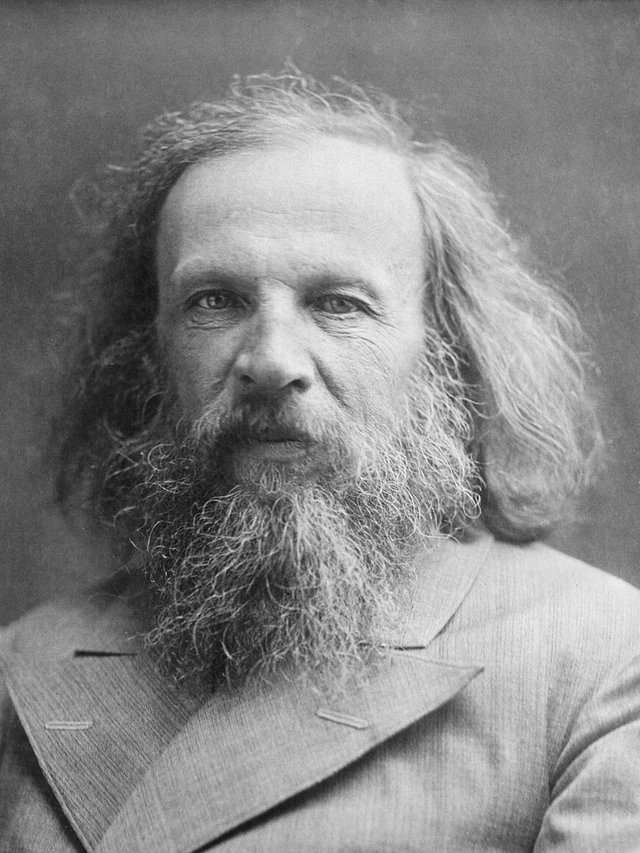

A life of discovery
The question they chased
Dmitri Mendeleev was born in 1834 in Siberia, near the city of Tobolsk. He was the youngest of many children. Sources say as many as 17, though that count is disputed. His father Ivan taught school until he went blind and lost his job. His mother Maria then ran the family's glass factory. When a fire destroyed it, she took Dmitri to Moscow in 1849 so he could go to university. The university turned him away. They went on to Saint Petersburg, where he entered the Main Pedagogical Institute in 1850.
Mendeleev became a chemistry teacher and professor. He wrote a major textbook, "The Principles of Chemistry." In 1869 he arranged the known elements by atomic weight and noticed their properties repeated in a pattern. Where the pattern broke, he left empty spaces. He said the spaces held elements nobody had found yet, and he described what they would be like. He was proved right.
The big ideas
What Dmitri figured out
Think of a calendar. Every seven days the pattern of weekdays starts over. Mendeleev saw that when elements are lined up by weight, their properties repeat in a similar way. That repeat is why the table is called periodic.
Mendeleev left blank spaces in his table on purpose. He predicted a missing element with a mass near 68 and a density near 6. Gallium turned up in 1875 with a mass of about 69.7 and a density of 5.9.
Predictions are risky. If they are wrong, the idea falls apart. Mendeleev predicted germanium would have a mass near 72 and a density of 5.5. When it was found in 1886 the real values were about 72.6 and 5.3. That success made scientists trust the table.
Key moments
How it unfolded
- 1850He entered the Main Pedagogical Institute in Saint Petersburg, the year his mother died.
- 1869He presented his periodic table, with gaps left for undiscovered elements.
- 1875Paul-Émile Lecoq de Boisbaudran discovered gallium, which fit Mendeleev's prediction.
- 1879Lars Fredrik Nilson found scandium, another predicted element.
- 1886Germanium was found and matched his predictions closely.
- 1906A Nobel committee recommended him, but the Swedish Academy chose Henri Moissan by one vote.
The person behind the science
The boy whose mother carried him to school
Mendeleev lost both parents before he was a grown man. His father died when he was about 13. His mother died in 1850, soon after getting him a place at school in Saint Petersburg. She had given up the family's factory and traveled far so he could be educated. Later in life, he knew public disappointment too. He remarried in 1882 after a divorce, and church rules about waiting caused a scandal. It was one reason he was not admitted to the Russian Academy of Sciences.
In 1906 the Nobel Committee recommended him for the prize in chemistry, but the Swedish Academy picked Henri Moissan by a single vote. He was nominated again in 1907. He died of influenza that year, on 2 February, at age 72. In between those losses, he kept teaching and writing. He resigned from Saint Petersburg University in 1890 and went on to lead the Bureau of Weights and Measures. His work did not need a prize to be right.
Small things that make them human
- A mother's gambleAfter a fire ruined the glass factory, Maria took her son far from home so he could be schooled.
- Youngest of manyHe was the youngest in a very large family, though historians dispute the number of siblings.
- A public scandalHis 1882 remarriage broke church rules about waiting. It helped keep him out of the Russian Academy of Sciences.
- One vote shortIn 1906 the Nobel prize went to Henri Moissan by one vote. Mendeleev was reportedly opposed by Svante Arrhenius.
A few surprising facts
Did you know
Element 101 is named mendelevium in his honor.
He said he saw the table in a dream. No one can check that, so treat it as his own story.
A popular tale says he invented 40 percent vodka. The Russian government set that standard in 1843, when he was nine years old.
He ran the Russian Bureau of Weights and Measures from the early 1890s until he died.
Why it still matters
What this means for you
Every science classroom has a periodic table on the wall, and the chart exists because one man trusted a pattern enough to leave blanks. He did not know the missing elements. He did know how to ask what would fit. That habit still drives science. Look for the pattern. Notice where it breaks. Predict what is missing. Then test it. His life also reminds a student that setbacks like lost parents, lost prizes, or public criticism are not the end of the story.
Leave room for what you do not know.
CURIOSITY ✦ RIGOR ✦ DISCOVERYTalk about it
Questions for your table
- Mendeleev's mother changed his life by taking a big risk for his education. Who has taken a risk to help you?
- Mendeleev lost the Nobel Prize by one vote. How do you stay proud of your work when you do not get the reward?
- He made bold predictions that could have been wrong. When is it worth taking a risk that you might be wrong?
Try it today
Three small steps
- Notice: Look at a periodic table and find a column where the elements share something, such as how strongly they react.
- Question: What pattern repeats in your week, your school year, or a song, and what would you predict next?
- Test: Sort ten household objects into a grid by two properties, leave one square empty, and predict what kind of object would fit that gap.