
BIOLOGY · GENETICS · INHERITANCE
Gregor Mendel
The Monk Who Counted Peas and Found a Hidden Rule
A farmer's son who failed his teaching exam grew thousands of pea plants and uncovered the rules of inheritance while almost no one noticed.
- 1822 to 1884
- Austrian Empire, now Czech Republic
- Life science

A life of discovery
The question they chased
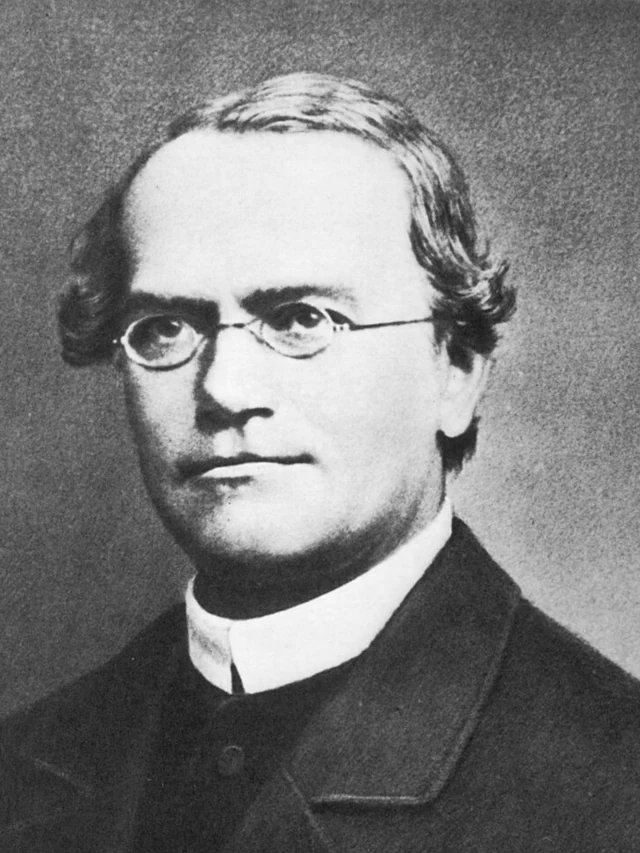
Gregor Mendel was born in 1822 in Heinzendorf, in Silesia, in what is now the Czech Republic. His family were farmers and money was tight. His sister Theresia gave him part of her dowry so he could stay in school. Illness forced him to take time off from his studies more than once. In 1843 he joined the Augustinian monastery in Brno, a place with books, gardens, and people who loved learning.
Mendel taught at a school, studied physics in Vienna from 1851, and then returned to Brno. From 1856 to 1863 he grew about 28,000 plants, most of them peas. He tracked traits such as seed color and counted each generation. In 1865 he read his results to a science society in Brno. His paper was published in 1866. Hardly anyone paid attention.
The big ideas
What Gregor figured out
People once thought traits blended like paint. Mendel found that they pass on as separate units. He called them factors. We now call them genes.
Mendel crossed pea plants with yellow seeds and plants with green seeds. The first generation was all yellow. In the next generation, about three plants had yellow seeds for every one with green. The green trait had not vanished. It had been hidden.
Mendel did not trust a few plants. He counted thousands. Large numbers showed a steady pattern. In the second generation, about one fourth were purebred for the hidden trait, half were mixed, and one fourth were purebred for the showing trait.
Key moments
How it unfolded
- 1843He entered the Augustinian monastery in Brno.
- 1850He failed the oral part of the exam to become a certified teacher.
- 1856He began the pea experiments that lasted until 1863.
- 1866His paper on plant inheritance was published and mostly ignored.
- 1868He became abbot of the monastery.
- 1900Scientists in Europe confirmed his findings, sixteen years after he died.
The person behind the science
The patient teacher behind the peas
Mendel failed the oral part of the teaching exam in 1850. He tried again in 1856 and failed again. He was clearly gifted, yet he could not pass the test that would make him a full teacher. Illness had cost him time in school. When his paper came out, it met silence. For most of his life his best work went unnoticed. He wrote in a short life story that his circumstances had decided his path, not a strong early calling.
Several things kept him going. His sister's gift. A monastery that gave him time, a garden, and a place to teach. A habit of careful counting that made him sure of what he had seen. People remembered him as a kind teacher. In 1868 he became abbot and took the duty seriously because he felt he owed the monastery for supporting his research. His science slowed. In his last years he was caught in a long tax dispute with the government that was not settled when he died in 1884.
Small things that make them human
- A sister's giftTheresia gave up part of her dowry so her brother could keep studying.
- Failed twiceHe did not pass the oral part of the teaching exam in 1850 or in 1856.
- A kind teacherPeople who knew him remembered him as a good and kind teacher.
- The unfinished fightA tax dispute between the monastery and the government went on until he died.
A few surprising facts
Did you know
Charles Darwin was working on evolution at the same time. He never read Mendel's paper.
For the first 35 years, other scientists cited the paper only about three times.
Most of what Mendel published was about weather. He helped start the Austrian Meteorological Society in 1865.
He kept bees, but his bees were aggressive and nearly all his bee records are lost.
Why it still matters
What this means for you
Mendel is a good reminder that a quiet result can still be true. His pea garden opened the way to modern genetics, which now helps farmers grow better crops and doctors understand inherited illness. His story also tells students something kind. Failing a test is not the final word on you. Careful work done with patience can wait years to be understood. And when you count and record honestly, the pattern will be there even if nobody is looking yet.
Count carefully. Trust the pattern. Keep going.
CURIOSITY ✦ RIGOR ✦ DISCOVERYTalk about it
Questions for your table
- Mendel failed the teaching exam twice and still did important work. How do you handle a failure on a test or goal?
- No one noticed his paper for many years. Why might good ideas go unnoticed, and what could you do to help share them?
- Mendel counted thousands of plants instead of a handful. When have you needed more evidence before making up your mind?
Try it today
Three small steps
- Notice: Look at siblings or classmates and list three traits that seem to run in families, like hair curl or dimples.
- Question: Why did Mendel count thousands of plants instead of just a handful?
- Test: Flip two coins 40 times and count how often you get two heads, one head, and no heads, then compare your results to a 1 to 2 to 1 pattern.