
BIOLOGY · MICROBES · MEDICINE
Louis Pasteur
The Tanner's Son Who Showed That Tiny Life Is Everywhere
A French chemist showed that invisible germs spoil food and cause disease, and he kept working through terrible loss to stop them.
- 1822 to 1895
- France
- Life science

A life of discovery
The question they chased
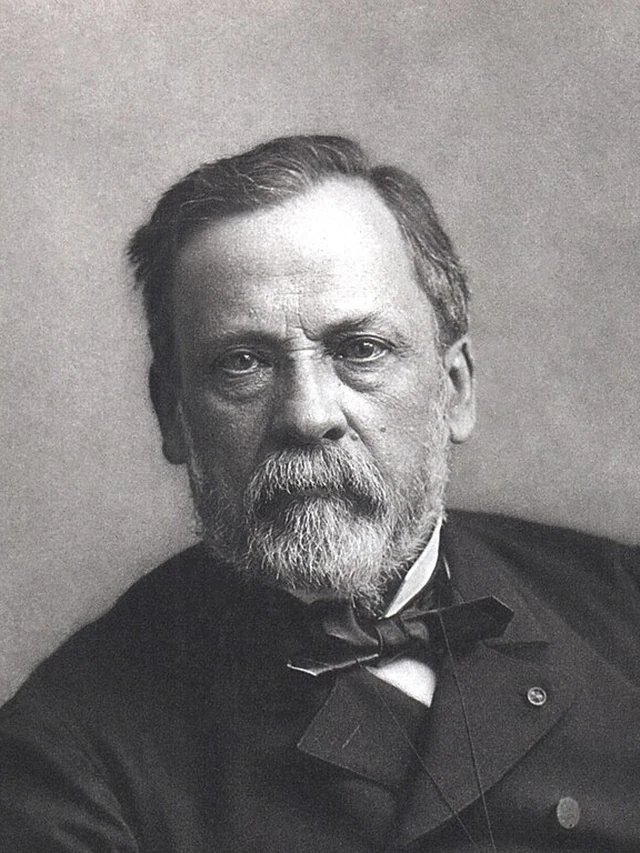
Louis Pasteur was born in 1822 in Dole, France, the son of a poor tanner. The family moved to Arbois when he was a young boy. He started out as a chemist. Studying tiny crystals of tartaric acid, he found that some were right handed and some were left handed. This was the first time anyone showed that molecules have a handedness. In 1849 he married Marie Laurent, who also became his scientific assistant.
Pasteur then turned to the invisible world. He showed that tiny living things, not magic, cause wine and milk to spoil. He found a way to protect wine by heating it, which was patented in 1865 and is now called pasteurization. He helped save the French silkworm industry from a disease. In his last years he worked on vaccines for anthrax and rabies. In 1888 the Pasteur Institute opened in Paris.
The big ideas
What Louis figured out
Pasteur used flasks with long, curved necks. Air could enter, but the bend trapped dust and germs. The liquid inside stayed clear. It only grew cloudy when the flask was tilted so the liquid touched the dust trap. Life did not appear from nothing. It came in from outside.
Heating a liquid such as milk to a certain temperature kills most of the germs in it. That idea is called pasteurization. Look for it on a juice or milk label.
A vaccine shows the body a harmless form of a germ so the body can learn to fight the real one later. Pasteur and his team worked on vaccines for anthrax and for rabies.
Key moments
How it unfolded
- 1849He married Marie Laurent, who worked beside him in the laboratory.
- 1865He patented his heating method for wine and began studying a silkworm disease.
- 1868A stroke paralyzed the left side of his body. He recovered.
- 1881A public test of an anthrax vaccine took place at Pouilly-le-Fort, run by his assistants.
- 1885A boy named Joseph Meister was treated for rabies and lived.
- 1888The Pasteur Institute opened in Paris.
The person behind the science
The father and the scientist
Pasteur and Marie had five children. Only two lived to adulthood. Their daughter Jeanne died of typhoid at age nine in 1859. Camille died at age two in 1865. Cécile died of typhoid at age twelve in 1866. These were years of deep grief. Pasteur kept working. He took on silkworm disease, then diseases of animals and people. In 1868 a stroke left the left side of his body paralyzed. He recovered and worked for 27 more years.
Marie stood beside him as wife and assistant. Younger scientists such as Roux and Chamberland shared his work and carried it forward. When young Joseph Meister arrived in July 1885, bitten by a rabid dog, the boy received 13 injections and stayed healthy. The Pasteur Institute's own history says Pasteur joined scientific ambition with care for people who were suffering.
Small things that make them human
- A poor startHe was the son of a tanner. Education opened the door for him.
- A team partnerMarie Laurent worked as his assistant as well as his wife.
- Back after a strokeHe had a stroke in 1868 at age 45 and still kept working for decades.
- The private notebooksHis grandson gave Pasteur's notebooks to the French national library in 1964. Historians who read them found his public accounts left some things out.
A few surprising facts
Did you know
The anthrax test was run by his assistants Émile Roux and Charles Chamberland.
Pasteur was a chemist, not a licensed doctor. Two physicians, Grancher and Vulpian, oversaw the rabies treatment of Joseph Meister.
His private notebooks stayed with his family until 1964. Historians who read them found that some of his public accounts left things out. People still argue about how much.
The institute he founded has won 10 Nobel Prizes.
Why it still matters
What this means for you
Every glass of pasteurized milk and every vaccine shot rests on ideas that Pasteur helped prove. He also shows the cost of caring about people. He lost three children young, and he kept pressing against disease. For a student, his life says that you can keep working with a heavy heart. It also says that honesty matters, since historians still debate parts of his story. Be curious about small things. Be honest about what you did.
See the tiny cause. Care for the person.
CURIOSITY ✦ RIGOR ✦ DISCOVERYTalk about it
Questions for your table
- Pasteur kept working after a stroke and the loss of three children. What helps you find strength when life gets very hard?
- Historians found that Pasteur's public accounts left some things out. Why does it matter for scientists to be fully honest about their methods?
- Pasteur noticed what other people missed in dust and crystals. What small detail in your own life might hold a big answer?
Try it today
Three small steps
- Notice: Read the label on a milk or juice carton and look for the word pasteurized.
- Question: What things in your home can spoil, and what keeps germs out of them?
- Test: With an adult, seal two slices of bread in clear bags, one with a damp paper towel and one dry, and write down what you see each day for a week without opening the bags.