
MATH · COMPUTING · IMAGINATION
Ada Lovelace
The Girl Who Saw What Computers Could Become
Born to a famous poet and raised on mathematics, she wrote notes about a machine that did not yet exist and glimpsed the future inside it.
- 1815 to 1852
- England
- Math
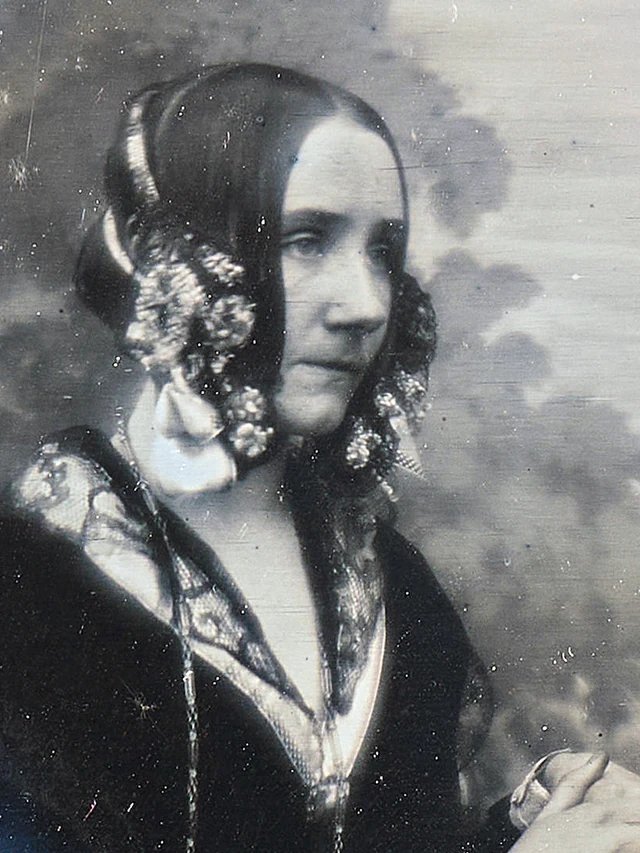

A life of discovery
The question they chased
Ada was born in London in 1815. Her father was the poet Lord Byron. Her parents separated a month after she was born, and her mother, Lady Byron, raised her. Ada's father died when she was eight, and she never really knew him. Her mother had Ada study mathematics and science, which were not usual subjects for girls then.
In 1833 a tutor and friend, Mary Somerville, introduced her to Charles Babbage. He was designing machines that could do math by gears and levers. His big design was the Analytical Engine, which was meant to follow stored instructions. In 1842 an Italian engineer wrote a paper about it in French. Ada translated it into English over about nine months and added seven notes of her own, signed with her initials. Her notes were about three times longer than the paper itself.
The big ideas
What Ada figured out
Most calculators of her day did one kind of job. Babbage's Analytical Engine was designed to take different instructions for different problems, like a modern computer. Ada's notes explained clearly how that would work. The machine was never built in her lifetime.
Ada saw that a machine that works on symbols need not stop at arithmetic. If notes of music could be turned into symbols, she wrote, the engine might compose music. That idea of one machine handling many kinds of information is the heart of today's computers.
Her seventh note, Note G, lays out step by step how the engine could calculate a list of numbers called Bernoulli numbers. It is often called the first published computer program. Historians still debate how much of it was her own and how much came from Babbage. The engine was never built, so the program was never run.
Key moments
How it unfolded
- 1828At age twelve she begins designing wings for flight and plans a book on the subject.
- 1829After measles she is paralyzed and spends almost a year in bed.
- 1833She meets Charles Babbage through Mary Somerville.
- 1835She marries William King, who later becomes the Earl of Lovelace.
- 1843Her translation and notes on the Analytical Engine are published.
- 1852She dies in London at the age of 36.
The person behind the science
The girl who would not stay in bed
Ada was often ill as a child. At eight she had headaches that affected her eyesight. After measles in 1829 she was paralyzed and spent nearly a year in bed. By 1831 she could walk with crutches. She learned to walk again, and in time she studied with tutors including Mary Somerville.
Her later years were also hard. She married and had three children, and she often struggled with her health. She once wrote that formulas that look very different but mean the same thing reminded her of sprites and fairies, who seem to change shape. Mary Somerville stayed her teacher and close friend for years. Ada died in 1852 of cancer at age 36. At her request, she was buried beside her father.
Small things that make them human
- A twelve-year-old inventorShe tested ideas for wings by studying birds and materials, and she planned a book about it.
- A friend and a teacherMary Somerville tutored Ada and introduced her to Babbage.
- A father she never knewHer parents separated a month after she was born, and Lord Byron died when she was eight.
- Math like fairiesAda compared formulas that change shape but stay equal to the sprites and fairies one reads about.
A few surprising facts
Did you know
At twelve, she studied bird anatomy and different materials to build wings for a flying machine. She planned to write a book called Flyology.
She called her way of thinking "poetical science," and she described herself as an "Analyst and Metaphysician."
She did not claim too much. She wrote that the engine had no pretensions whatever to originate anything.
Calling her the first programmer is debated. Babbage wrote earlier, unpublished programs, and some historians say her role has been overstated while others defend it.
Why it still matters
What this means for you
Ada saw an idea that is now inside every phone and laptop. A machine can follow instructions and work with words, pictures, and sound as well as numbers. She also showed that imagination belongs in math and science. She knew a machine could not think up new ideas without people. That question about what computers can and cannot do is one you will still be asking.
Imagination can build the path first.
CURIOSITY ✦ RIGOR ✦ DISCOVERYTalk about it
Questions for your table
- Ada was sick for long stretches yet kept learning. What helps you keep going when something is hard or you feel unwell?
- She said science could be poetical. Where do you see creativity in math or science class?
- Ada saw uses for a machine that did not exist. What tool do you wish existed, and what would it do?
Try it today
Three small steps
- Notice: Write down five steps a person follows to make a sandwich, in order, with no step skipped.
- Question: Ask what would go wrong if one step were missing or out of order.
- Test: Give your steps to a friend and have them follow them exactly, then see where the instructions need fixing.