
ASTRONOMY · MOTION · TELESCOPE
Galileo Galilei
The Man Who Opened the Night Sky
He turned a new telescope on the night sky, saw worlds no one had seen, and paid a heavy price for sharing it.
- 1564 to 1642
- Italy
- Astronomy
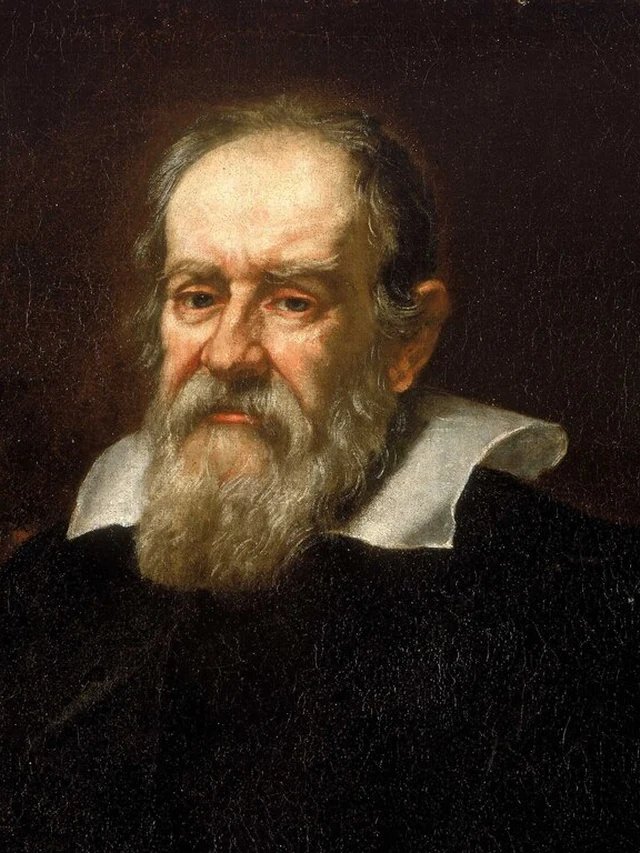
A life of discovery
The question they chased
Galileo was born in Pisa, Italy, in 1564. His father, Vincenzo, was a lutenist and music theorist. In 1580 Galileo enrolled at the University of Pisa to study medicine. After a geometry lecture he switched to mathematics and the study of nature. He taught at the University of Padua from 1592 to 1610 and wanted to know how things really move and what lies above us.
In March 1610 he published “The Starry Messenger.” With a telescope he had seen mountains on the Moon and four large moons circling Jupiter. Later he saw the phases of Venus and spots on the Sun. He also studied how objects speed up as they fall and roll. In 1632 he published a book comparing the Earth-centered and Sun-centered views. It got him into trouble that lasted the rest of his life.
The big ideas
What Galileo figured out
Through his telescope, Galileo saw four small lights near Jupiter that changed places night after night. They were moons circling Jupiter. So not everything in the sky circles the Earth.
Galileo saw Venus shift from a thin crescent to a nearly full disk, like the Moon. That pattern fit the Sun-centered picture and did not fit Ptolemy's old picture. It was strong visible evidence.
Falling things are fast, so he slowed them down. In his last book he describes rolling balls down ramps to show that speed builds up steadily. He used experiments and math to describe motion.
Key moments
How it unfolded
- 1564He is born in Pisa.
- 1610“The Starry Messenger” reports Jupiter's moons and more.
- 1633The Inquisition finds him “vehemently suspect of heresy.” He is sentenced to house arrest for life.
- 1634His daughter Maria Celeste dies at age 33.
- 1638He goes blind, and his book “Two New Sciences” is published in Holland.
- 1642He dies at Arcetri, near Florence, on 8 January.
The person behind the science
The father who kept writing
Galileo had three children with Marina Gamba, two daughters and a son. He placed both daughters in the convent of San Matteo when the older was about 13. Virginia took the name Sister Maria Celeste in 1616. In 1616 he was also warned to stop holding or teaching the Sun-centered view. Years later Pope Urban VIII, once friendly to him, thought a character in his 1632 book mocked him. The book was banned, and in 1633 Galileo, nearly 70, was found vehemently suspect of heresy. He lived under house arrest for the rest of his life. He remained a member of the Church.
Maria Celeste held him up. She wrote him 124 letters between 1623 and 1633. She served as the convent's apothecary and sent him herbal remedies, and she managed its money. Soon after he returned to Arcetri, she died of dysentery in April 1634. He called her a woman of exquisite mind and singular goodness, tenderly attached to him. He kept working. His book “Two New Sciences” appeared in 1638, the same year he went blind. His pupil Vincenzo Viviani stayed close and later wrote his life story.
Small things that make them human
- A musician's sonHis father, Vincenzo Galilei, was a lutenist and music theorist who wanted his son in medicine.
- Fixing the conventHe repaired the convent's windows and kept its clock in order.
- Letters that survivedMaria Celeste's 124 letters were found among his papers after his death.
- Blind but publishingIn 1638 he lost his sight, and his best book was published in Holland the same year.
A few surprising facts
Did you know
The story that he dropped balls from the Leaning Tower of Pisa comes from his student Vincenzo Viviani. Historians generally consider it at most a thought experiment.
The line “And yet it moves” has no evidence behind it. The earliest written account appears about a century after his death.
One hundred twenty-four letters from his daughter Maria Celeste survive. His replies are lost.
The Church dropped its general ban on books teaching the Sun-centered view in 1758, and in 1992 Pope John Paul II spoke of the error of the theologians of Galileo's time.
Why it still matters
What this means for you
Galileo taught the world to check ideas against what we can observe. When he looked up, he trusted his eyes and kept honest records. A student today can do the same with a notebook and a question. His story is also about love and faithfulness. A daughter wrote to her father, and a father kept working when the world turned hard. Both are worth remembering.
Look carefully, then report what you see.
CURIOSITY ✦ RIGOR ✦ DISCOVERYTalk about it
Questions for your table
- Galileo trusted what he saw through the telescope over what he had been taught. When have you had to trust evidence over a popular idea?
- His daughter stood by him through a hard time. Who helps you when things get hard, and how can you help them?
- He kept working after he lost his freedom and later his sight. What helps you keep going when something is taken away?
Try it today
Three small steps
- Notice: Look at the Moon or a bright planet on a clear night and sketch what you see.
- Question: Ask how you could tell whether a bright dot is a star or a planet by watching it for a week.
- Test: Roll a ball down a ramp and mark its position each second to see if the gaps grow.