
ASTRONOMY · PLANETS · ORBITS
Johannes Kepler
The Man Who Found the Shape of the Heavens
A sickly, often penniless astronomer trusted eight tiny arcminutes of data over his own beautiful theory and found how the planets move.
- 1571 to 1630
- Germany
- Astronomy
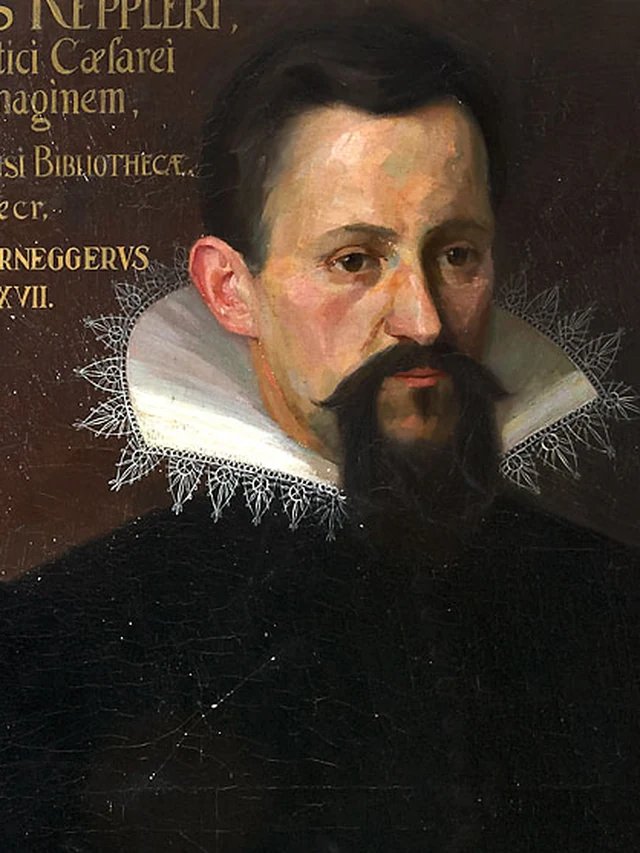

A life of discovery
The question they chased
Johannes Kepler was born in 1571 in Weil der Stadt, in what is now Germany. He came early and sickly. Smallpox left him with weak eyes and hurt hands, which made watching the night sky hard. So he leaned on mathematics instead. He wanted to know why the planets move as they do, and whether there was a pattern God had built in.
In 1600 he went to work with the astronomer Tycho Brahe, who had the best measurements of planet positions in Europe. After Tycho died in 1601, Kepler took over his notes. Years of work on Mars led to two laws in 1609 and a third in 1619. Planets move in ovals called ellipses. They speed up when near the Sun. And a planet's year is tied to its distance from the Sun.
The big ideas
What Johannes figured out
An ellipse is a stretched circle. The Sun sits at one special point inside it, not in the middle. Before Kepler, almost everyone assumed planets had to move in perfect circles.
Draw a line from the Sun to a planet. That line sweeps out the same area in the same time. So when the planet is close to the Sun, it must move faster to cover that area. When it is far away, it slows down.
Kepler found that the time a planet takes to go around depends on its distance in a steady way. Square the time and you get the distance cubed, up to a fixed number. A far planet like Saturn takes about 29 years, while Mercury takes 88 days.
Key moments
How it unfolded
- 1600Kepler meets Tycho Brahe near Prague and begins working with him.
- 1601Tycho dies and Kepler becomes imperial mathematician.
- 1609"Astronomia nova" is published with his first two laws.
- 1611His wife Barbara and his young son die.
- 1619"Harmonice Mundi" appears with his third law.
- 1627The Rudolphine Tables are printed, the star and planet tables Tycho had hoped for.
The person behind the science
The man who kept going when things fell apart
Kepler's life had one hard loss after another. In 1611 his wife Barbara fell ill and died, and one of his young sons died the same year. Two of his other children had died as babies. He remarried in 1613, partly because his children needed someone to care for them.
Then his mother, Katharina, was accused of witchcraft. She was an herbalist in her seventies, and the charges grew until there were dozens. Kepler took over her defense. He paused his own work and moved his family to southern Germany. He wrote careful arguments and asked the law faculty at Tübingen for help. She was held for over a year, refused to confess, and was set free on 4 October 1621. She died about six months later.
Small things that make them human
- A story about a motherIn "Somnium" a boy's mother is a wise woman who knows spirits. Kepler believed copies of the draft fed the rumors about Katharina.
- Paid late, or neverThe emperor's treasury was often short of money. Kepler spent years chasing what he was owed and made his last trip, to Regensburg, to collect it.
- War cost him a libraryDuring the Thirty Years' War, Catholic authorities took his library in 1625 and a siege and fire hit Linz in 1626.
- He admitted mistakesKepler wrote openly about his wrong turns and dead ends. That honesty is part of why we can follow how he found the truth.
A few surprising facts
Did you know
He called his years of Mars calculations his war with Mars.
When he finally saw his mistake with the ellipse, he called himself a foolish bird.
His story "Somnium" imagines a trip to the Moon. It was published in 1634 after his death, and some people call it an early work of science fiction.
He lived through the Thirty Years' War. At times he was owed so much money that he left home to ask for it.
Why it still matters
What this means for you
Kepler is proof that a discovery can come from taking a small mismatch seriously. His own idea was close, but eight arcminutes was too much to ignore. He wrote that those eight minutes alone would lead to reforming all of astronomy. Today astronomers still use his laws to place satellites and track planets around other stars. And his life shows that someone can lose a great deal, feel unsupported, and still finish the work.
Honor the small number that disagrees.
CURIOSITY ✦ RIGOR ✦ DISCOVERYTalk about it
Questions for your table
- Kepler gave up a theory he liked because the data did not match. When have you had to change your mind about something you wanted to be true?
- Kepler stopped his own work to defend his mother. What would you set aside for someone you love, and what helps you decide?
- He kept working during years of loss and war. What helps you keep going when life is hard around you?
Try it today
Three small steps
- Notice: Look at the Moon tonight and again in three nights, and write down how its shape and position changed.
- Question: Ask yourself which of your guesses at school or home could be checked with one careful measurement.
- Test: Tie a weight to a string, swing it in a circle, then shorten the string and see whether it goes around faster.
- Sources.
- https://en.wikipedia.org/wiki/Johannes_Kepler
- https://en.wikipedia.org/wiki/Astronomia_nova
- https://en.wikipedia.org/wiki/Somnium_(novel)
- https://mathshistory.st-andrews.ac.uk/Biographies/Kepler/
- https://www.cam.ac.uk/research/news/the-astronomer-and-the-witch-how-kepler-saved-his-mother-from-the-stake