
PHYSICS · QUANTUM · WAVES
Erwin Schrödinger
The Physicist Who Gave the Atom a Wave Equation
He wrote the wave equation of the atom, dreamed up a cat to question quantum rules, and twice left a country behind.
- 1887 to 1961
- Austria and Ireland
- Physics
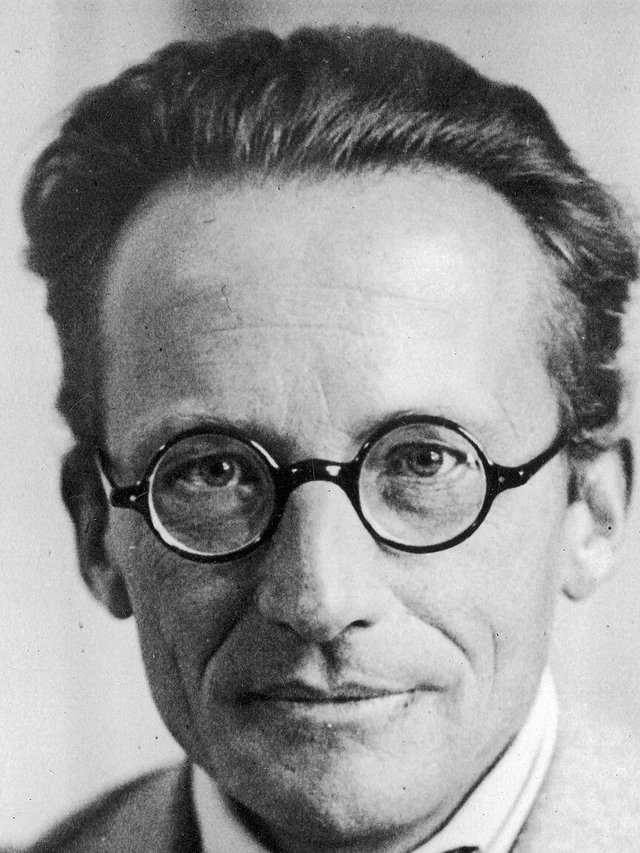

A life of discovery
The question they chased
Erwin Schrödinger was born in Vienna in 1887, the only child of Rudolf, a man who loved botany. At school he enjoyed science, ancient grammar, and German poetry, but he disliked memorizing. He studied physics at the University of Vienna from 1906 to 1910. In the First World War he served as an artillery officer. After the war he chased a hard puzzle about the atom, which was why electrons inside atoms have only certain energies.
In 1926 he published the paper that gave physics the equation now named for him. It treats the electron as a wave, and it gave the right energies for hydrogen. In 1933 he shared the Nobel Prize in Physics with Paul Dirac. Soon after, he left Germany because he strongly disapproved of how the Nazis treated Jewish people.
The big ideas
What Erwin figured out
Schrödinger's equation tells how a particle's wave changes over time. A guitar string can vibrate in only certain patterns, so it plays only certain notes. An electron's wave fits around an atom in only certain patterns, so the electron has only certain energies.
In 1935, after writing back and forth with Einstein, Schrödinger described an imaginary cat in a sealed box. Its fate depends on one quantum event. If quantum rules covered the whole box, the cat would be both alive and dead until someone looked, and he meant that as a puzzle about the rules. No real cat was ever put in a box.
In his 1944 book "What Is Life?" Schrödinger asked how a living thing could pass its traits to the next generation. He suggested a molecule that carries a kind of code. The book inspired James Watson and influenced Francis Crick as they worked toward the structure of DNA.
Key moments
How it unfolded
- 1926Schrödinger publishes "Quantisierung als Eigenwertproblem," which presents his wave equation.
- 1933He shares the Nobel Prize in Physics with Paul Dirac and leaves Germany for a fellowship at Magdalen College, Oxford.
- 1935After long letters with Einstein, he describes the thought experiment that became known as Schrödinger's cat.
- 1938After Austria is taken over by Germany, his university in Graz dismisses him for political unreliability, and he flees to Italy.
- 1944He publishes "What Is Life?"
- 1956He returns to Vienna as a professor emeritus at the University of Vienna.
The person behind the science
A thinker who kept moving
In 1933 Schrödinger was at the top of his field. He had taken Max Planck's old post in Berlin and was about to win a Nobel Prize. Even so, he chose to leave Germany because he could not accept what was happening to Jewish colleagues. Oxford gave him a home for a while, and he turned down a permanent job at Princeton in 1934. He went back to Austria in 1936 to work in Graz, and two years later he was dismissed and had to flee again. Within five years he had left two countries.
His wife, Annemarie, whom he married in 1920, was his companion for the rest of his life. Dublin became his long stay, and the new Institute for Advanced Studies there gave him a place to build a school of theoretical physics. He stayed from 1940 until he retired in 1955. His long friendship and arguments with Albert Einstein helped shape the cat puzzle. In 1956 he returned to Vienna, and he died there in January 1961 at the age of 73.
Small things that make them human
- Poetry and old languagesAs a schoolboy he loved German poetry and the grammar of ancient languages.
- Hated rote learningHe disliked memorizing facts and preferred to understand why things work.
- A philosophical streakHe felt the pull of philosophy so strongly that he thought of changing careers in 1918.
- Letters with EinsteinTheir long exchange pushed both men to sharpen their ideas about quantum theory.
A few surprising facts
Did you know
In 1918 he briefly thought about leaving physics for philosophy.
In 1920 he published three papers on how humans see color.
He was drawn to Indian philosophy, including the Upanishads, and to the thinkers Schopenhauer and Spinoza.
Irish leader Éamon de Valera invited him to Dublin, where he led the School of Theoretical Physics and became an Irish citizen in 1948.
Why it still matters
What this means for you
Schrödinger's equation is used today to design computer chips, lasers, and medicines. His cat reminds students that even famous scientists argue about what a theory means. His life shows that a good mind can be forced to move, and that new homes and new colleagues can keep the work going. And his book about life helped point other scientists toward DNA.
Ask what the equation really means.
CURIOSITY ✦ RIGOR ✦ DISCOVERYTalk about it
Questions for your table
- Schrödinger left a high-ranking job because of what he thought was right. When have you stood by a belief even though it cost you something?
- He disliked memorizing and wanted to understand why. Which subject do you understand best, and what helped you get there?
- His thought experiment was meant to test an idea, not prove it. How can making up a story or example help you test whether you really understand something?
Try it today
Three small steps
- Notice: Pluck a rubber band, a ruler hanging off a table, or a guitar string and listen for the note it makes.
- Question: Ask why a string can make only certain notes and not every sound in between.
- Test: Tie a rope or long string to a doorknob, shake the free end at different speeds, and see which speeds make clear wave patterns.