
ASTRONOMY · GALAXIES · EXPANSION
Edwin Hubble
The Man Who Made the Universe Bigger
He showed that our galaxy is one of many, and then found that those galaxies are moving apart.
- 1889 to 1953
- United States
- Astronomy
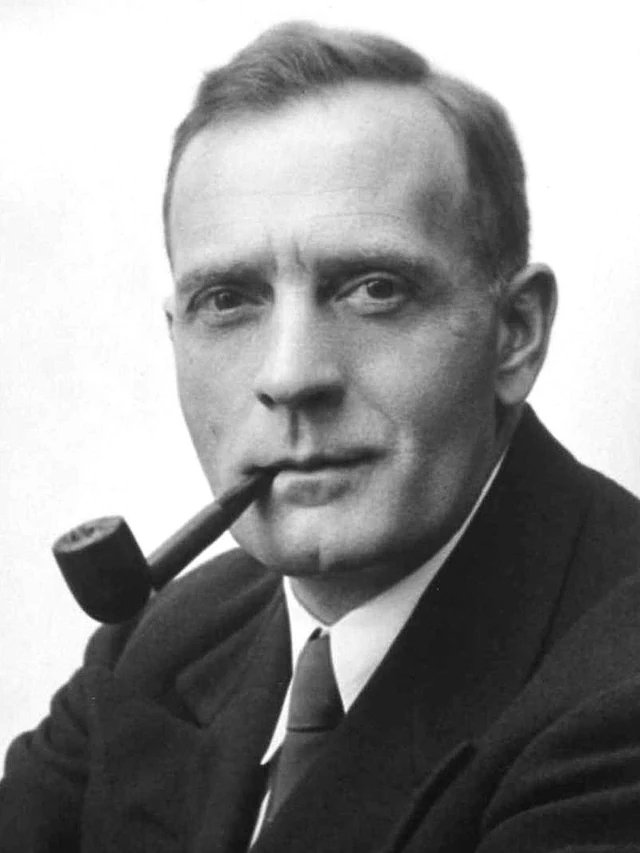

A life of discovery
The question they chased
Edwin Hubble was born in 1889 in Marshfield, Missouri. As a young man he was better known for sports than for science. He played several sports at the University of Chicago and led its basketball team to a Big Ten title in 1907. Then he won a Rhodes Scholarship to Oxford, where he studied law because his dying father had asked him to. He would turn back to the sky.
In 1919 Hubble joined the Mount Wilson Observatory in California, and he worked there for the rest of his life. In those days many astronomers believed the Milky Way was the whole universe. They thought the fuzzy patches called nebulae were clouds inside it. Hubble's careful measurements in 1923 and 1924 showed that Andromeda lies far outside our galaxy. In 1929 he and his helper Milton Humason showed that the farther away a galaxy is, the faster it moves away from us.
The big ideas
What Edwin figured out
Hubble found a kind of pulsing star in Andromeda. The rhythm of that star tells astronomers how bright it really is, so how dim it looks tells how far away it must be. The answer put Andromeda far outside the Milky Way.
When a galaxy moves away, its light is stretched toward the red end of the spectrum. It is a bit like a siren that drops in pitch as it drives away. Hubble and Humason compared the stretching with distance and found that farther galaxies are stretched more.
Think of dots drawn on a balloon being blown up. Every dot moves away from every other dot, and dots farther apart separate faster. Georges Lemaître had predicted this pattern in 1927, and Hubble's measurements gave strong support.
Key moments
How it unfolded
- 1919George Ellery Hale hires Hubble to work at Mount Wilson Observatory near Pasadena, California.
- 1924Hubble marries Grace Burke.
- 1924His observations show that Andromeda and other nebulae are galaxies far outside the Milky Way, and the news is announced on January 1, 1925.
- 1929Hubble and Milton Humason report that the speed at which galaxies move away grows with their distance.
- 1940sDuring World War Two he serves the Army at Aberdeen Proving Ground and earns the Legion of Merit.
- 1953Hubble dies in San Marino, California, and soon afterward the Nobel committee makes astronomical work eligible for the physics prize.
The person behind the science
The athlete who became an observer
Hubble first did what his father asked and studied law. Afterward he worked as a high school teacher and basketball coach in New Albany, Indiana. Then he turned back to astronomy and finished his training. He joined the Army in 1918 and rose to major, though his division never saw combat.
Hubble liked to describe himself as an observer who preferred measuring to guessing. Late in his career he pushed hard for astronomers to be allowed to win the Nobel Prize in Physics. The rule changed only after he died, and the prize is never given after death. His name sits on Hubble's law, but Lemaître had predicted the pattern and Humason had measured many of the redshifts. His wife Grace saved his papers, and after she died in 1980 they went to the Huntington Library.
Small things that make them human
- A sports star firstHe set a state high jump record in 1906 and played on the Chicago team that won a Big Ten title.
- Two careers, one telescopeHe gave up law for the sky and spent the rest of his career with the Mount Wilson telescopes.
- A partner at the eyepieceHumason photographed faint galaxies and measured the redshifts that Hubble used.
- Rules and rankHe wanted astronomy to be a branch of physics so that astronomers could be honored.
A few surprising facts
Did you know
He came home from Oxford with British manners and dress, and they sometimes annoyed his American colleagues.
Milton Humason left school at 14 and first came to Mount Wilson as a mule driver and then a janitor, yet he became one of the best observers of faint galaxies.
Hubble's first distance scale was off, and astronomers corrected it later.
He never won a Nobel Prize because astronomy did not count as physics while he lived. The Hubble Space Telescope carries his name.
Why it still matters
What this means for you
Every picture from the Hubble Space Telescope rests on the idea that the universe is full of galaxies and that it is growing. Students can see in this story how a big discovery needs patient measuring, a good partner, and a willingness to correct numbers later. Hubble also shows that a person can change direction. He went from law and basketball to the stars, and what he found changed how humans see their place in space.
Measure carefully, then follow the light.
CURIOSITY ✦ RIGOR ✦ DISCOVERYTalk about it
Questions for your table
- Hubble did what his father asked and later returned to what drew him. How do you decide between what others expect of you and what you want to do?
- Milton Humason started as a mule driver and became a skilled observer without a degree. Who do you know who has skills that grades do not show?
- Hubble's first distances were off, and others corrected them. How do you feel when someone fixes your work, and how could you use that to get better?
Try it today
Three small steps
- Notice: Look at a clear night sky or a photo of one and pick out the brightest and faintest stars you can find.
- Question: Ask how astronomers can tell whether a faint star is far away or just dim.
- Test: Draw dots on a balloon with a marker, blow it up a little at a time, and measure how the distances between dots grow.