
PHYSICS · ATOMS · QUANTUM
Niels Bohr
The Man Who Taught Electrons Their Rules
A Danish goalkeeper turned physicist explained why atoms glow in exact colors, then spent his later years working for peace.
- 1885 to 1962
- Denmark
- Physics
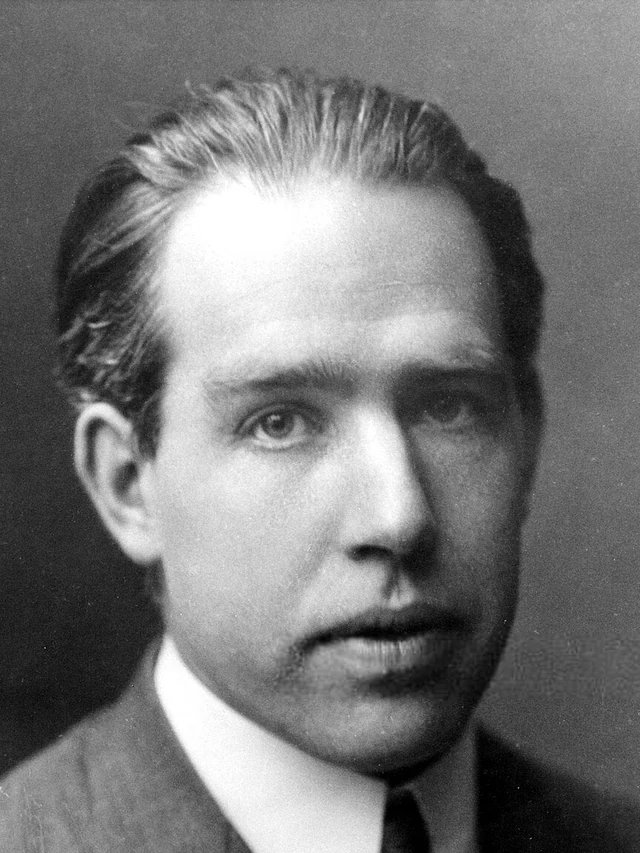

A life of discovery
The question they chased
Niels Bohr was born in Copenhagen in 1885. His father, Christian, was a professor of physiology, and his brother Harald became a mathematician. Niels studied physics at the University of Copenhagen and earned his doctorate in 1911. He also played goalkeeper for a local soccer club called Akademisk Boldklub. His big question was about the atom. Rutherford had shown that an atom has a tiny nucleus, but nobody could explain why electrons around it did not simply spiral into it.
Bohr went to Cambridge in 1911, where he did not impress J. J. Thomson. Then Rutherford invited him to Manchester in 1912. In 1913 Bohr published a series of three papers with a new model of the atom. He proposed that electrons can only exist at certain fixed energy levels. He won the Nobel Prize in Physics in 1922. By then he was head of his own institute in Copenhagen, which opened in 1921.
The big ideas
What Niels figured out
Bohr said an electron in an atom cannot have just any energy. It can only sit on certain steps, like standing on a staircase and never between the stairs. On those steps it does not give off light. This was his answer to why atoms stay stable.
When an electron drops from a higher step to a lower one, the atom gives off light with an exact amount of energy. Each jump gives a certain color. This explained why hydrogen glows in a few sharp colors and not in a smooth rainbow. His model fit hydrogen well, and later physics refined the picture for bigger atoms.
In 1927 Bohr proposed complementarity. Light and tiny particles act like waves in some experiments and like particles in others. No single experiment shows both at once. Bohr said we need both pictures to describe the whole.
Key moments
How it unfolded
- 1912He works with Rutherford in Manchester and marries Margrethe Nørlund.
- 1913He publishes his model of the atom with fixed energy levels.
- 1921His Institute for Theoretical Physics opens in Copenhagen.
- 1922He receives the Nobel Prize in Physics for his work on atomic structure.
- 1943He escapes occupied Denmark by sea to Sweden and then travels to Britain and the United States.
- 1950He writes an open letter to the United Nations calling for openness and peaceful use of atomic energy.
The person behind the science
The friendly arguer
Bohr had a family, and he also knew sorrow. He and Margrethe had six sons. Two of them died young. In 1934 his son Christian died in a boating accident. In 1943, when the Nazis occupied his country, he had to flee in secret. He left his home and his institute in Copenhagen and went to work in Britain and the United States.
Bohr was known for friendly debates. He had good-natured arguments with Albert Einstein about what quantum theory means. After the war he used his fame to speak up. He wanted the new power of the atom used for peace. In his 1950 open letter to the United Nations he asked countries to share knowledge instead of hiding it. In 1957 he received the first Atoms for Peace Award.
Small things that make them human
- A goalkeeper at heartHe kept goal for Akademisk Boldklub in Copenhagen.
- A brother to lean onHarald was both his brother and a fellow scientist.
- Friendly with a rivalHis good-natured arguments with Einstein are famous in physics.
- Six sons, two lost youngHe and Margrethe raised six sons together, and two died young.
A few surprising facts
Did you know
Bohr was a goalkeeper, and his brother Harald played for Denmark at the 1908 Olympics. Harald became a famous mathematician.
His time at Cambridge went badly. He did not impress J. J. Thomson, and he moved to Manchester to work with Rutherford.
He escaped from Nazi-occupied Denmark on 29 September 1943 by boat to Sweden. A week later he was flown to Britain.
Element 107 on the periodic table is named bohrium in his honor.
Why it still matters
What this means for you
Energy levels like the ones Bohr described help explain why neon signs and fireworks glow in certain colors. His life shows that science works best as a conversation. He learned from Rutherford, argued with Einstein, and led an institute where physicists worked together. He also spoke up about how atomic science should be used. When you ask a hard question in class, you are doing what he did.
Argue kindly and keep learning.
CURIOSITY ✦ RIGOR ✦ DISCOVERYTalk about it
Questions for your table
- Bohr learned from friendly arguments with Einstein. How do you handle it when someone disagrees with you?
- His time at Cambridge was a letdown, but Manchester was the right fit. Have you ever had to try a different place before things clicked?
- Bohr spoke up about how atomic science should be used. When should people who know a lot speak up?
Try it today
Three small steps
- Notice: Look at a fluorescent light, a neon sign, or a candle flame and write down the colors you see.
- Question: Ask why a glowing thing gives off one color instead of every color.
- Test: Hold a CD or a prism up to a light and see if the colors spread into a rainbow or stay in a few lines.