
EARTH · MAPS · MEASUREMENT
Eratosthenes
The Man Who Measured the Whole Earth With a Shadow
He lived in the great library of Alexandria and used shadows and simple arithmetic to measure the whole planet.
- about 276 BC to about 194 BC
- Libya and Egypt
- Earth science
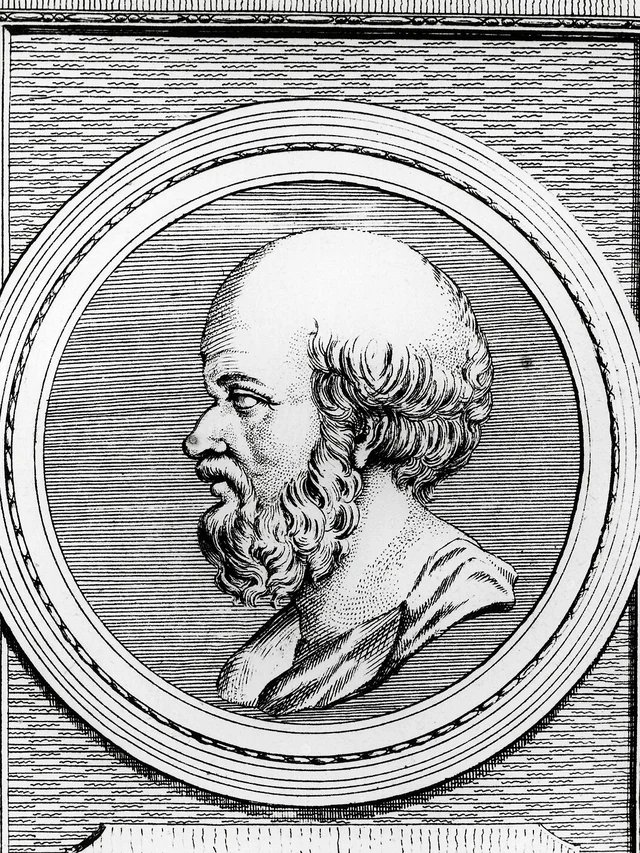

A life of discovery
The question they chased
Eratosthenes was born around 276 BC in Cyrene, a Greek city in what is now Libya. He studied in Athens for about twenty years. Then King Ptolemy III summoned him to Alexandria, Egypt, to run the great library. He wanted to know the shape of the world and how big it is.
He learned that at noon on the summer solstice the Sun cast no shadow in the city of Syene. In Alexandria, to the north, a shadow appeared at the same hour. He measured the angle of that shadow, about 7.2 degrees, which is one fiftieth of a circle. He used the distance between the cities, roughly 5,000 stadia, and multiplied by 50. His answer was about 250,000 stadia around the Earth.
The big ideas
What Eratosthenes figured out
If the Sun is straight overhead in one city and tilted in another, the angle tells you how far apart they are around a curve. His angle was one fiftieth of a full circle. So the distance between the cities must be one fiftieth of the way around the Earth.
He drew a world map in a work called “Geographica,” using parallel lines and meridians and naming more than 400 cities. The book is lost, and about 155 fragments survive, mostly through the writer Strabo.
He wrongly assumed Syene sat exactly on the Tropic of Cancer and due south of Alexandria. Those errors partly canceled. How close his answer was depends on the length of the stadion, which scholars still debate.
Key moments
How it unfolded
- About 276 BCHe is born in Cyrene.
- Late 260s BCHe begins about twenty years of study in Athens.
- After 246 BCPtolemy III summons him to Alexandria to run the library.
- Third century BCHe estimates the size of the Earth, a method preserved by the later writer Cleomedes.
- About 194 BCHe dies in Alexandria at about 80 years old.
The person behind the science
The all-rounder with a nickname
Eratosthenes did not leave a diary, so what we know about his feelings is thin. A later source, the Suda, written more than a thousand years after his death, says critics called him Beta, or Second. It says he was good at many things and the best at none. We cannot know how he felt about the name, or even whether it was meant to sting. The same source says admirers called him Pentathlos. He was a poet, a mathematician, a geographer, an astronomer, and a librarian.
He left home as a young man to study for about twenty years in Athens, far from Cyrene. Then he was called to Alexandria, a historian suggests partly because of his Cyrenean roots and Queen Berenike. The great Archimedes addressed his letter called “The Method” to Eratosthenes. Late in life, one tradition says his sight failed. That comes from a source written long after his death, so we treat it only as a tradition.
Small things that make them human
- Called SecondCritics are said to have nicknamed him Beta. A later source says so, and it is tradition.
- Student from far awayHe grew up in Cyrene and spent about twenty years studying in Athens.
- Respected by ArchimedesArchimedes chose Eratosthenes as the reader of his letter called “The Method.”
- Poet and scientistHe wrote poetry as well as science, and a surviving book on the constellations is linked to his name, though scholars debate how much of it is his.
A few surprising facts
Did you know
A later source says critics nicknamed him Beta, which means Second, because he often came in second. Admirers called him Pentathlos, the all-rounder, an athlete who competes in five events.
His own book on measuring the Earth is lost. We know the method mostly through Cleomedes, who wrote centuries later.
He estimated the tilt of Earth's axis at about 23.9 degrees. That is close to the modern value of about 23.4.
Only fragments of his writing survive. A book on the constellations carries his name, though scholars doubt the text we have is exactly his. He was also a poet.
Why it still matters
What this means for you
Eratosthenes shows that a big measurement can come from a stick, a shadow, and careful thinking. He did not need a spaceship. He needed two places, one angle, and the nerve to multiply. Scientists still do the same, from measuring distances to stars to mapping coastlines. And his nickname reminds a student that being called second does not stop the work from lasting.
Big questions can start with shadows.
CURIOSITY ✦ RIGOR ✦ DISCOVERYTalk about it
Questions for your table
- Eratosthenes used two cities and one shadow to size a planet. What big thing could you measure with something small?
- He was nicknamed Second. How do you handle a label that others give you, and what do you want to be known for?
- His errors partly canceled out. Why is it important to be honest about what you do not know in your measurements?
Try it today
Three small steps
- Notice: At noon, measure the shadow of a pole or a meter stick and write it down.
- Question: Ask a friend in another town to measure the same shadow at the same time and compare.
- Test: Use both shadow lengths and the stick height to work out each angle and estimate the distance between you.