
MATH · LEVERS · FLOATING
Archimedes
The Man Who Weighed Imaginary Slices of the World
In a Greek city on Sicily, he worked out why levers lift, why ships float, and how to trap the value of pi.
- about 287 BC to 212 BC
- Sicily, in the Greek world
- Math

A life of discovery
The question they chased
Archimedes lived in Syracuse, a Greek city on the island of Sicily. He was born around 287 BC. His father's name was Phidias, and that is nearly all the record says about his family. He chased one plain goal. He wanted a few clear rules that explain how levers, floating objects, and curved shapes really behave.
He wrote a book on the lever and a book called “On Floating Bodies.” He trapped the circle between straight-sided shapes to pin down pi. He proved that a sphere fills exactly two thirds of the cylinder that fits snugly around it. Several of his books survive, and his careful proofs are still studied today.
The big ideas
What Archimedes figured out
A lever balances when each weight times its distance from the pivot comes out equal. A small weight far from the pivot can balance a big weight close to it. Picture a seesaw with a light child far back and a heavy adult near the middle.
A fluid pushes up on anything placed in it. The push equals the weight of the fluid the object shoves aside. A steel ship floats because its wide hull shoves aside a huge amount of water, and that water weighs as much as the ship.
He drew a shape with 96 straight sides inside a circle and another outside it. The circle had to fit between them. That told him pi is a little over 3.140 and a little under 3.143.
Key moments
How it unfolded
- About 287 BCHe is born in Syracuse, a date worked out from a later writer who says he lived 75 years.
- 214 BCRome begins its siege of Syracuse, and ancient writers say his war machines helped the city hold out for two years.
- 212 BCSyracuse falls to Rome and Archimedes dies in the city, though ancient writers disagree about the details.
- About 75 BCThe Roman writer Cicero reports finding Archimedes' forgotten tomb under brambles.
- 1906Scholars recognize his writing hidden beneath the text of a medieval prayer book.
- 1998That book, the Archimedes Palimpsest, sells at auction to a private buyer.
The person behind the science
The thinker who showed his work
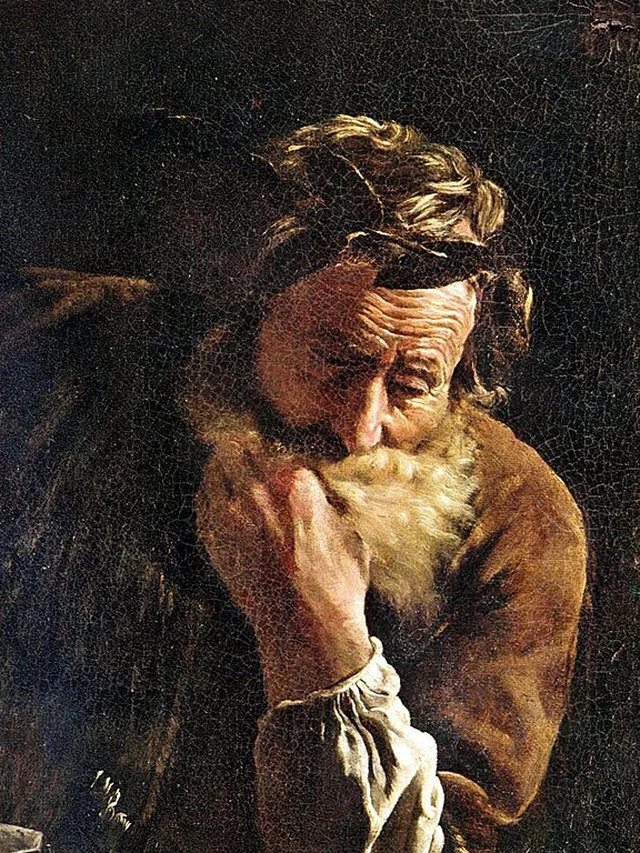
We have no diary and no letters about his feelings. We do not even have a portrait. What we have is his writing, and it shows a mind that loved being honest about how it worked. He wrote a letter called “The Method” to Eratosthenes, a scholar in Alexandria. In it he admitted that he found some results by imagining he was weighing thin slices of a shape on a balance. He did not count that as proof. So he proved the same results again, the slow and careful way.
When Rome attacked Syracuse, Plutarch, Livy, and Polybius all describe war machines built to defend the city. Catapults. Cranes with a great iron claw. Archimedes is tied to them in these accounts. Plutarch also claimed he looked down on practical work, but modern scholars think that picture is wrong. Ancient writers disagree on how he died when Rome took the city in 212 BC, and we will not guess. What lasted was the work. His writing was copied, hidden, rescued, and read again.
Small things that make them human
- A family left blankHis father was Phidias. Plutarch says Archimedes was related to King Hiero II, while Cicero suggests a humble start. No one knows.
- Honest about his methodHe told Eratosthenes plainly that his balance trick found answers but did not prove them.
- A tomb he chosePlutarch says Archimedes wanted a sphere and cylinder on his tomb. Cicero says he found a tomb with those shapes carved on it.
- Legends come lateThe shouted word Eureka comes from Vitruvius, two centuries afterward. Only his books are solid record.
A few surprising facts
Did you know
He wrote “The Sand Reckoner,” a short book about counting the grains of sand that could fill the universe. He invented a way to name huge numbers, and his answer comes to about 8 times 10 to the 63rd power in our notation.
In the 1200s a scribe scraped the ink off old copies of his work and reused the pages for a prayer book. The words survived underneath. That book is the only source for his treatise called “The Method.”
The famous bathtub story about the king's crown was first told by the writer Vitruvius, about two centuries after Archimedes died. The idea that he burned ships with mirrors appears only in much later writing. Treat both as tradition.
The Archimedes screw, a spiral that lifts water, probably existed before him. Early writers who describe it do not give him the credit.
Why it still matters
What this means for you
Archimedes shows that a big idea can start with a lever, a bathtub, or a circle. He also shows a habit every student can use. Find your answer any way you can, then prove it properly. Engineers still use buoyancy and leverage to design ships, cranes, and bridges. And his rescued pages are a reminder that good work can be lost for centuries and still come back.
Find it first. Then prove it.
CURIOSITY ✦ RIGOR ✦ DISCOVERYTalk about it
Questions for your table
- Archimedes admitted that his balance trick was not a real proof. When have you gotten an answer a quick way and then had to check it the slow way?
- His writing was scraped off and reused, yet it was saved. What work of yours or your family's deserves to be saved, and who could help save it?
- Many stories about him are legends that grew later. How can you tell a record from a story when you read about a famous person?
Try it today
Three small steps
- Notice: Find a seesaw, a crowbar, or a door and see where pushing is easiest, near the hinge or far from it.
- Question: Ask what makes a heavy object float in one pan of water but sink in another when you add salt.
- Test: Float a ball of clay, then shape the same clay into a boat and count how many pennies it holds.