
ASTRONOMY · STARS · HYDROGEN
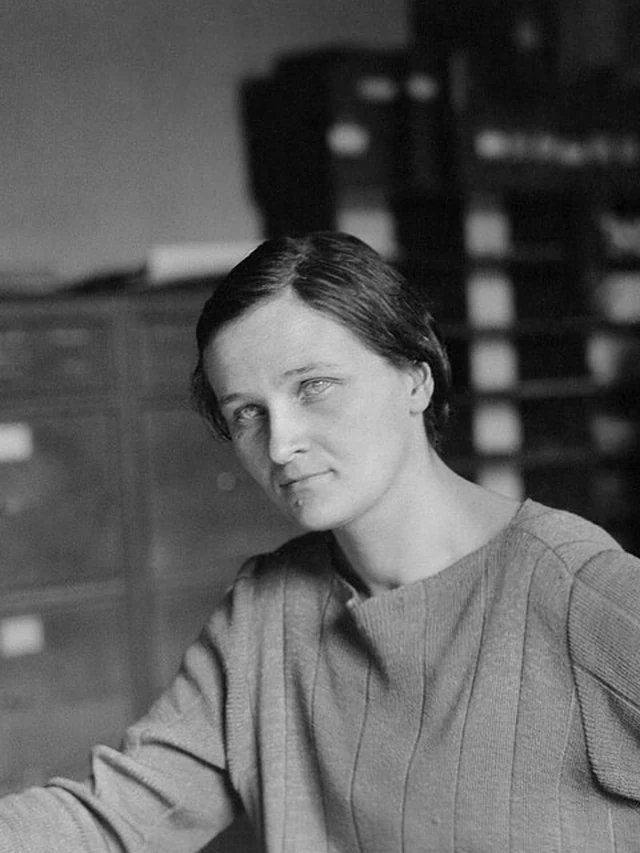
Cecilia Payne-Gaposchkin
The Astronomer Who Was Told She Was Wrong, and Was Right
In her twenties she found what stars are made of, and the leading expert in the field told her she must be wrong.
- 1900 to 1979
- United Kingdom and United States
- Astronomy

A life of discovery
The question they chased
Cecilia Payne was born in Wendover, England, in 1900. She studied at Newnham College, Cambridge, and finished the three-year course in two years. A lecture by Arthur Eddington about the eclipse that tested Einstein's theory turned her toward astronomy. Cambridge gave no degrees to women until 1948, so she left without one. Her big question was what stars are made of.
In 1923 she moved to Harvard, where Harlow Shapley ran the observatory. She studied starlight spread into a spectrum, where each chemical leaves its own lines. She worked out how temperature changes which lines show up. In 1925 her thesis, "Stellar Atmospheres," argued that stars are mostly hydrogen and helium. She was the first person to earn a doctorate in astronomy from Radcliffe College.
The big ideas
What Cecilia figured out
Light from a star can be split into a rainbow crossed by dark lines. Each element leaves its own pattern of lines. By reading them, astronomers learn what a star is made of without going anywhere near it.
Temperature changes atoms, and that changes the lines they leave. Hydrogen lines can look weak in a very hot star or a cool one even when hydrogen is plentiful. Payne used this idea to read stars more correctly.
Hydrogen and helium make up most of the Sun and the stars. Heavier elements are only a small share. Before her, many astronomers expected stars to be built like Earth.
Key moments
How it unfolded
- 1919She begins at Newnham College, Cambridge.
- 1923She moves to Harvard to work with Harlow Shapley.
- 1925She earns her doctorate at Radcliffe with a thesis arguing stars are mostly hydrogen and helium.
- 1929Henry Norris Russell reaches the same result by other means and acknowledges her earlier work.
- 1934She marries the astrophysicist Sergei Gaposchkin.
- 1956She is the first woman promoted to full professor from within Harvard's Faculty of Arts and Sciences.
The person behind the science
The scientist who kept going without the title
Payne's path was not easy. Cambridge gave her no degree. Harvard did not grant doctorates to women then, so her PhD came from Radcliffe. When her thesis said stars were mostly hydrogen, Henry Norris Russell, an astronomer she respected, urged her not to claim it. She wrote in her thesis that the result was almost certainly not real. Four years later Russell reached the same answer by other means, and he was widely credited.
She taught popular courses and edited the observatory's publications, but she was not recognized as faculty for many years. In 1934 she married Sergei Gaposchkin, a Russian-born astrophysicist. She had met him in Germany in 1933 and helped him get a visa to the United States. They raised three children, Edward, Katherine, and Peter. In 1956 Harvard made her a full professor.
Small things that make them human
- Her own choice of subjectAt Newnham she insisted on physics instead of the usual botany, chemistry, and zoology.
- Helping a friend come overShe helped Sergei get a visa to the United States before they married.
- A name joined togetherShe hyphenated her surname rather than taking his name entirely.
- Her own story in printHer autobiography, edited by her daughter Katherine Haramundanis, was published by Cambridge University Press in 1996.
A few surprising facts
Did you know
Cambridge let her finish her studies but gave her no degree, because it did not grant degrees to women until 1948.
Her thesis included a line saying her hydrogen result was almost certainly not real. She added it after Russell objected.
Astronomer Otto Struve later called her thesis the most brilliant PhD thesis ever written in astronomy.
She and her assistants made more than 1,250,000 observations of variable stars.
Why it still matters
What this means for you
Payne shows that being right and being believed are not always the same thing. She did the measurements, trusted the physics, and wrote her result down, even with a doubt attached. The work held up. Today we know ordinary matter in stars is mostly hydrogen and helium. If you ever get an answer that goes against what experts say, check it carefully and then say it plainly.
Trust the evidence, even when it surprises you.
CURIOSITY ✦ RIGOR ✦ DISCOVERYTalk about it
Questions for your table
- Payne added a line doubting her own result because an expert disagreed. When is it right to hold your ground, and when is it right to wait for more proof?
- She got no degree and a small title. How do you keep doing your best when you are not getting credit?
- She helped a friend come to the United States. Who has helped you get somewhere, and who could you help?
Try it today
Three small steps
- Notice: Look at light from a streetlamp, a candle, and an LED bulb and write down how their colors differ.
- Question: Ask why one lamp looks warmer or cooler than another and what that might say about its temperature.
- Test: Use a CD or a glass prism in sunlight to spread light into a rainbow on a wall and count the colors you can see.