
PHYSICS · QUANTUM · CURIOSITY
Richard Feynman
The Physicist Who Refused to Be Fooled
He explained how light and matter touch, played the bongos, cracked combination locks, and showed the nation what went wrong with a rubber ring.
- 1918 to 1988
- United States
- Physics
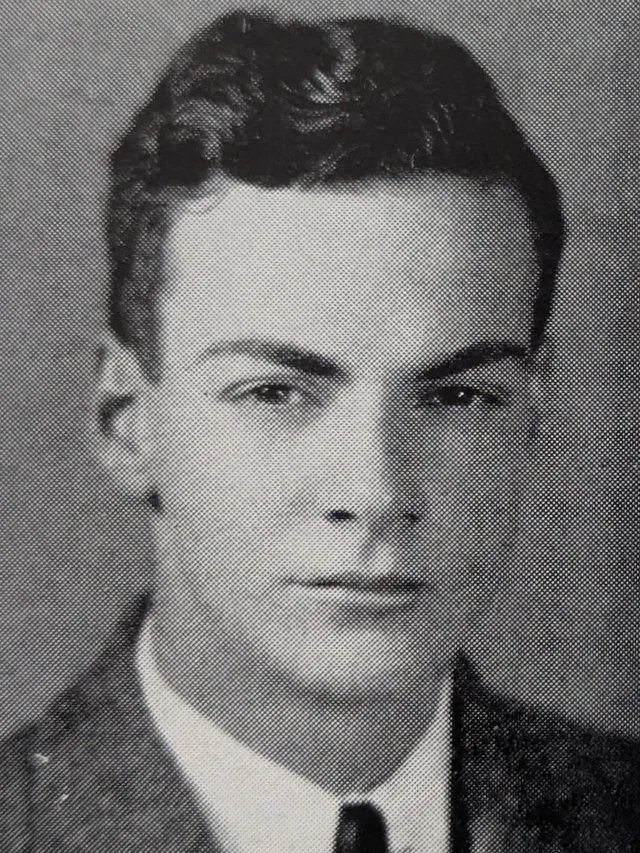

A life of discovery
The question they chased
Richard Feynman was born in New York City in 1918. His father, Melville, encouraged him to question what he was told. He studied physics at MIT, finished a PhD at Princeton in 1942, and married his high school sweetheart, Arline Greenbaum. He wanted to know how light and matter really interact. And he wanted to explain it in pictures he could understand.
In 1943 he joined the Manhattan Project at Los Alamos, where he worked in Hans Bethe's theory group. After the war he taught at Cornell and later at Caltech. In 1948 he showed other physicists his drawings of particle paths, now called Feynman diagrams. Freeman Dyson helped make clear how useful they were. In 1965 Feynman shared the Nobel Prize in Physics with Julian Schwinger and Shin'ichirō Tomonaga for their work on quantum electrodynamics.
The big ideas
What Richard figured out
A Feynman diagram is a simple drawing of what particles do. Lines show particles, and where lines meet, something happens. Each little drawing stands for a piece of math that would otherwise fill pages.
Quantum electrodynamics, or QED, is the theory of how light and charged particles like electrons interact. Its predictions match experiments with remarkable precision. It describes how atoms absorb and give off light.
In 1986 the Space Shuttle Challenger was lost after launching on a cold morning. Feynman served on the commission that looked into why. In a televised hearing he squeezed a piece of the rubber O-ring material in a clamp, dipped it in ice water, and showed that it lost its springiness in the cold.
Key moments
How it unfolded
- 1942He finishes his PhD at Princeton and marries Arline Greenbaum on June 29.
- 1943He moves to Los Alamos to work on the Manhattan Project.
- 1948At the Pocono Conference he presents his diagrams, and many listeners are puzzled.
- 1961He begins teaching the Caltech lectures that become "The Feynman Lectures on Physics," published with Robert Leighton and Matthew Sands.
- 1965He shares the Nobel Prize in Physics for quantum electrodynamics.
- 1986He serves on the Rogers Commission and demonstrates what cold does to the rubber O-ring.
The person behind the science
The player who also grieved
Feynman married Arline in June 1942, while she had tuberculosis. She died on June 16, 1945, and he had spent hours at her side. After his father died in October 1946, Feynman suffered from depression. He was 28.
He kept teaching, kept drumming, and kept working. At Caltech he held the Richard C. Tolman professorship. In 1960 he married Gweneth Howarth, and they had a son, Carl, and later adopted a daughter, Michelle. Even while fighting cancer, he served on the Challenger commission.
Small things that make them human
- A father who asked questionsMelville Feynman encouraged his son to question orthodox thinking.
- A sweetheart from high schoolArline Greenbaum was his high school sweetheart before she was his wife.
- A letter kept sealedOn October 17, 1946, he wrote Arline a letter. It stayed sealed until after his own death.
- A daughter by adoptionHe and Gweneth adopted Michelle in 1968.
A few surprising facts
Did you know
At Los Alamos he opened colleagues' combination locks for fun. One cabinet opened to 27, 18, 28, which are the first digits of the number e.
He loved playing bongo and conga drums. While in Brazil in 1951 and 1952 he learned the frigideira, a metal percussion instrument.
He wanted a drum on the cover of his lecture books. They came out with plain red covers.
His appendix to the Challenger report said that for a successful technology, reality must come before public relations, because nature cannot be fooled.
Why it still matters
What this means for you
Feynman shows that you can take hard ideas seriously and still enjoy them. He drew pictures to understand things. He asked plain questions. At a national hearing he used a clamp and a cup of ice water instead of a speech. A student can do the same. When something does not make sense, find a simple test and watch what happens. Reality comes before reputation.
Keep asking until it makes sense.
CURIOSITY ✦ RIGOR ✦ DISCOVERYTalk about it
Questions for your table
- Feynman lost his wife and then his father within about a year and a half. What helps people you know keep going after a loss, and what could you do to help?
- He used a clamp and ice water to show what was wrong. When have you shown something with a simple demo instead of an argument?
- His father taught him to question what he was told. How do you decide when to question something and when to trust it?
Try it today
Three small steps
- Notice: Pick one everyday thing, like a zipper or a faucet, and try to explain how it works before you look it up.
- Question: Ask what the simplest picture is that explains how something works, then draw it.
- Test: Put one rubber band in the freezer for ten minutes, then stretch it and compare it with one that stayed at room temperature.