
PHYSICS · NUCLEAR · PARITY
Chien-Shiung Wu
The Woman Who Proved Nature Can Tell a World from Its Mirror
She ran the experiment that showed nature is not the same in a mirror, and then watched others take the prize.
- 1912 to 1997
- China and United States
- Physics
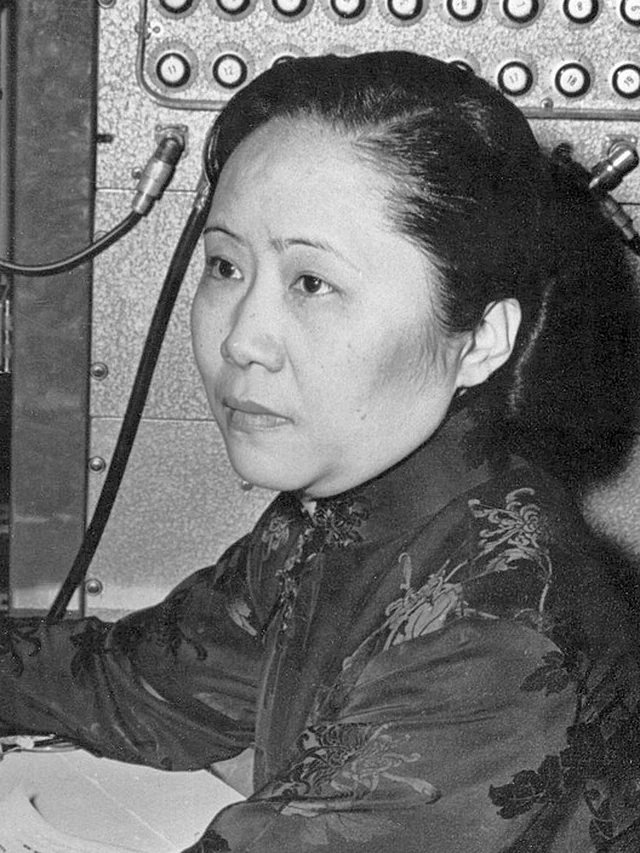

A life of discovery
The question they chased
Chien-Shiung Wu was born in 1912 in Liuhe, a town near Shanghai. Her father, Wu Zhong-Yi, founded a school for girls, which was rare at the time. She graduated first in her class and studied at National Central University in Nanjing. In 1936 she sailed to California to study physics at Berkeley. The question she chased was how the tiny particles inside atoms really behave.
At Berkeley she earned her PhD in 1940. She taught at Smith College, then at Princeton, and in March 1944 she joined the Manhattan Project at Columbia University. She worked on radiation detectors there. Her earlier research on xenon also helped identify why a reactor at Hanford kept shutting down. After the war she stayed at Columbia and became a leader in the study of beta decay.
The big ideas
What Chien-Shiung figured out
Physicists long believed that the laws of nature work the same in a mirror image of an experiment. This idea is called parity. In 1956 Tsung-Dao Lee and Chen Ning Yang asked whether it holds for the weak force, which drives beta decay.
Wu's team lined up the spins of cobalt-60 nuclei with a magnetic field and chilled them to about one hundredth of a degree above absolute zero. Then they measured which way the electrons flew out, and most went opposite the spin. In a mirror the pattern would flip, so the world and its mirror image are not identical.
A result that overturns a rule trusted for about thirty years needs a second look. Within days, Leon Lederman's team at Columbia tested parity a different way, using the decay of pions and muons. They found the same break from mirror symmetry.
Key moments
How it unfolded
- 1936She sails to the United States to study physics.
- 1940She earns her PhD at the University of California, Berkeley.
- 1944She joins the Manhattan Project's laboratory at Columbia University.
- 1956Between Christmas and New Year's, her team at the National Bureau of Standards sees beta emission favor one direction.
- 1957Lee and Yang receive the Nobel Prize in Physics for the parity idea.
- 1975She becomes the first woman president of the American Physical Society.
The person behind the science
The daughter who could not go home
In 1949 China's government changed, and Wu's father urged her not to return. She stayed in the United States and became a citizen in 1954. Then came losses. Her brother died in 1958, her father in 1959, and her mother in 1962. Travel restrictions between the countries kept her from attending the funerals in China.
She kept her place in science anyway. She married fellow physicist Luke Yuan in 1942, and their son Vincent was born in 1947. In 1958 she became a full professor at Columbia and was elected to the National Academy of Sciences. Colleagues respected her work so much that people steered clear of beta decay experiments because she would do them better. In 1975 she became the first woman president of the American Physical Society.
Small things that make them human
- A school for girlsHer father founded the Ming De school for girls in Liuhe.
- First in her classShe graduated first in her class in 1929 before entering university.
- A wedding at a famous homeShe married Luke Yuan on May 30, 1942, at the home of physicist Robert Millikan.
- Pay made fairIn 1975, the year she led the American Physical Society, her pay was brought in line with that of male colleagues.
A few surprising facts
Did you know
The 1957 Nobel Prize in Physics went to Lee and Yang. Wu, whose experiment proved their idea, was not included.
In 1978 she received the first Wolf Prize in Physics.
An uncle helped her pay for the trip to the United States in 1936. She picked Berkeley over the University of Michigan.
Physicist Maurice Goldhaber said that people avoided beta decay experiments because Wu would do them better.
Why it still matters
What this means for you
Wu's experiment overturned a rule physicists had trusted for about thirty years. That is a reminder that a rule is only as strong as the test it survived. Every time you run a lab and the result surprises you, you are doing the same kind of science she did. She also shows how to keep going when credit is slow. She kept doing excellent work, and the field noticed.
Test the rule, then trust the result.
CURIOSITY ✦ RIGOR ✦ DISCOVERYTalk about it
Questions for your table
- Wu left her family and country at 24 to study. What would you need to feel brave enough to do that?
- She was left out of a Nobel Prize for her own experiment. How should a group decide who gets credit?
- A rule everyone trusted turned out not to be always true. What is something you were sure about that you later learned was more complicated?
Try it today
Three small steps
- Notice: Hold a small object up to a mirror and write down one thing that looks the same and one that looks reversed.
- Question: Ask why a left glove does not fit a right hand, and what that says about shapes and mirrors.
- Test: Write the letters of your name on paper, hold the page up to a mirror, and list which letters look the same in the mirror.