
CHEMISTRY · PHYSICS · RADIOACTIVITY
Marie Curie
The Woman Who Found Light Inside Rock
She lost her mother, her husband, and her good name in the press, and still discovered two elements and won two Nobel Prizes.
- 1867 to 1934
- Poland and France
- Chemistry
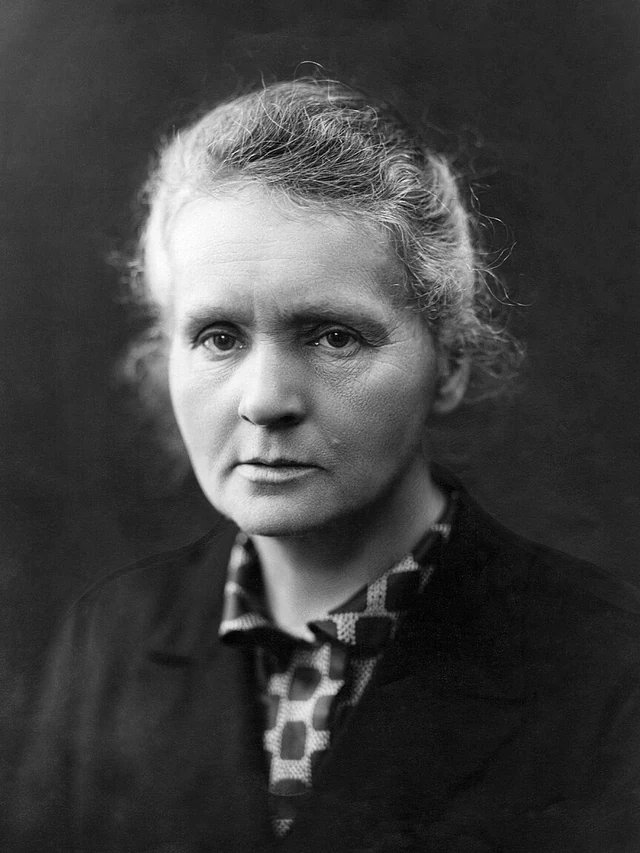

A life of discovery
The question they chased
Marie was born Maria Skłodowska in Warsaw in 1867, when Poland was ruled by the Russian Empire. Her mother died of tuberculosis when Marie was ten. Her sister Zofia had died of typhus a few years earlier. Women could not attend the university in Warsaw, so Marie studied in a secret school called the Flying University. In 1891 she moved to Paris to study at the Sorbonne. She married the physicist Pierre Curie in 1895.
In 1896 Henri Becquerel found that uranium gives off invisible rays on its own. Marie chose to study this for her doctorate. She noticed that a mineral called pitchblende was more radioactive than the uranium in it could explain. Something else had to be hiding inside. She and Pierre refined the ore in an old shed, and in 1898 they announced two new elements. They named one polonium for her homeland. The other was radium.
The big ideas
What Marie figured out
Some atoms are unstable and give off energy and particles without any help. That is radioactivity. Marie showed it comes from the atoms and does not depend on the chemical form they are in. Whatever compound the atoms were in, the rays kept coming.
Think of a scale that reads far too heavy for what is on it. Marie measured pitchblende and found it gave off more radiation than the uranium inside could account for. She reasoned that other, stronger radioactive elements were mixed in. Her careful measurements led her to polonium and radium.
X-rays let doctors see broken bones and metal inside the body. During World War I Marie helped build mobile X-ray units, nicknamed "petites Curies," and took them to field hospitals. It is often estimated that more than a million wounded soldiers were examined with X-ray units like hers.
Key moments
How it unfolded
- 1898The Curies announce polonium and radium.
- 1903She shares the Nobel Prize in Physics with Pierre and Henri Becquerel.
- 1906Pierre dies in a street accident, and in November Marie gives his lecture course at the Sorbonne.
- 1911She wins the Nobel Prize in Chemistry for her work on radium and polonium.
- 1914 to 1918During World War I she builds and directs mobile X-ray units for field hospitals.
- 1934She dies in France at the age of 66.
The person behind the science
The woman behind the lab coat
Marie knew grief young. She lost her sister and her mother before she was a teenager. In April 1906 Pierre was killed in a street accident in Paris. His death devastated her. She moved with her two daughters and her father-in-law to Sceaux, where Pierre was buried. Then she took over his teaching. On 5 November 1906 she became the first woman professor at the Sorbonne. She gave a plain lecture and did not mention the loss. Work became a lifeline.
The hardest public stretch came in 1911. The French Academy of Sciences turned her down by one or two votes, and newspapers attacked her private life. An angry crowd gathered outside her home. She and her daughters stayed with her friend Camille Marbo. A month after accepting her second Nobel Prize she was hospitalized with depression and a kidney illness. She recovered and went on to direct a laboratory and serve in the war. Friends, family, and helpers in the house kept the household steady.
Small things that make them human
- A wedding in dark blueShe wore a dark blue outfit to marry Pierre in 1895, not a bridal gown, and they held no religious service.
- A school for the childrenFrom 1907 she helped run a small school where parents who were scientists took turns teaching Irène and other children.
- Her daughter at her sideSeventeen-year-old Irène helped her run X-ray units during the war.
- A daughter's bookHer younger daughter, Ève, later wrote a biography called "Madame Curie."
A few surprising facts
Did you know
The 1903 Nobel committee first planned to honor only Pierre and Becquerel. After a Swedish mathematician warned Pierre, Marie's name was added.
Her notebooks from the 1890s are still too radioactive to handle safely. They are kept in lead-lined boxes, and even her cookbooks are radioactive.
She named polonium after Poland on purpose. Poland was not an independent country then, and she wanted the world to notice.
In 1995 she became the first woman buried in the Panthéon in Paris on her own achievements. Her remains were sealed in lead.
Why it still matters
What this means for you
Marie Curie's work gave us ways to see inside the body and to treat cancer. It also taught scientists how radiation can harm, which is why radiation safety rules exist today. Her life shows that grief and unfair treatment do not have to end a person's work. She kept going, with help from people who loved her. If you ever feel you have lost too much to keep going, her story says to lean on those people and take the next small step.
Do the next careful thing.
CURIOSITY ✦ RIGOR ✦ DISCOVERYTalk about it
Questions for your table
- Marie went back to work soon after Pierre died. What helps you carry on after a loss, and who can help you?
- Women were barred from the University of Warsaw, so Marie joined a secret school. What would you do if a door to learning were closed to you?
- She kept measuring even when the numbers did not match what she expected. Why does an odd result matter in science and in life?
Try it today
Three small steps
- Notice: Find one measurement at home, like the weight of a bag of flour or the temperature of a room, and write it down twice with a gap of an hour.
- Question: Ask what could cause two readings to differ.
- Test: Measure again with a different tool and compare to see which result you trust more.