
ATOMS · CHEMISTRY · WEATHER
John Dalton
The Quaker Teacher Who Gave Atoms Their Weight
He kept a weather diary for 57 years and saw colours differently from most people. John Dalton still gave chemistry its modern atoms.
- 1766 to 1844
- England
- Chemistry
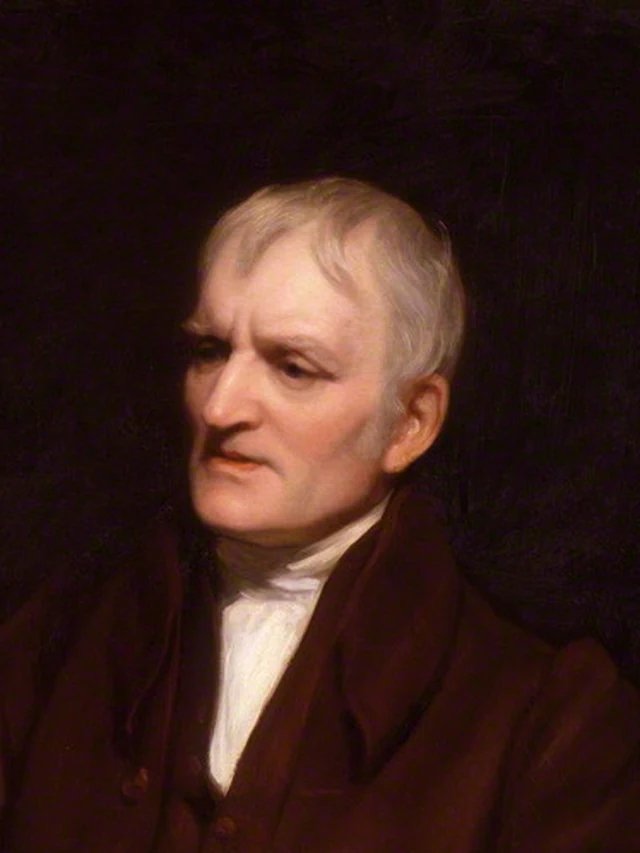

A life of discovery
The question they chased
John Dalton was born in 1766 in the village of Eaglesfield in Cumberland, England, into a Quaker family. He first learned from his father and from a Quaker schoolmaster named John Fletcher. By age ten he was earning a living working for a wealthy local Quaker, Elihu Robinson. He later taught for about twelve years in Kendal, then moved to Manchester in 1793. All his life he kept asking what the air is made of and why gases mix.
In 1787 he began a weather diary and kept it for 57 years. His study of air led him to the law of partial pressures. It says that in a mixture of gases, each gas pushes as if it were alone. From there he proposed that each element is made of atoms of its own kind, with its own weight, and that compounds form when atoms join in fixed whole-number ratios. He explained this in “A New System of Chemical Philosophy” in 1808.
The big ideas
What John figured out
Dalton said all atoms of one element are the same, and atoms of different elements differ in weight. A gold atom is not a lead atom. Every chemical change is atoms rearranging, not appearing or vanishing.
Atoms join in simple counts. Carbon and oxygen can make carbon monoxide or carbon dioxide. The second has exactly twice as much oxygen for the same amount of carbon. Dalton's idea explained why chemical recipes come out in neat steps instead of random amounts.
Air is a mixture. Each gas in it pushes on the walls as if it were alone, and the total pressure is the sum. Dalton's law of partial pressures is why scientists can talk about the oxygen pressure in the air or in a tank.
Key moments
How it unfolded
- 1766John is born in Eaglesfield in Cumberland.
- 1787He starts a weather diary that he will keep for 57 years.
- 1794He gives the first recorded description of colour blindness to the Manchester Literary and Philosophical Society.
- 1808He publishes his atomic theory in “A New System of Chemical Philosophy.”
- 1826The Royal Society gives him its Royal Medal.
- 1844He dies in Manchester on 27 July.
The person behind the science
The quiet teacher from Cumberland
Dalton never married and lived modestly. When he first told people about his colours, many took it as a joke. He would ask whether a flower was blue or pink, and they thought he was joking. It took time and a brother who saw the same thing for him to realize the difference was real. He wrote to his old employer Elihu Robinson that he had found with certainty that colours looked different to him.
In 1837 and 1838 he had small strokes, and the second one affected his speech. He kept experimenting anyway. He had another stroke in May 1844. On 26 July, with a trembling hand, he wrote down his last weather observation. A friend, Dr. Joseph Ransome, carried out his wish and examined his eyes after he died, with the chemist George Wilson present. He also led the Manchester Literary and Philosophical Society for many years.
Small things that make them human
- A teacher early onA Quaker teacher, John Fletcher, taught him, and a Quaker employer, Elihu Robinson, gave him work at ten.
- DaltonismIn some languages the word for colour blindness is still Daltonism, after him.
- Fifty-seven years of weatherHe recorded the weather from 1787 until the day before he died.
- A willing loserHe asked for an examination that would test his own idea, and he accepted the result.
A few surprising facts
Did you know
He discovered his colour difference when a pink flower looked sky-blue by daylight and reddish by candlelight to him, but not to others.
His brother saw colours the same odd way, which helped Dalton see that the trait runs in families.
He asked that his eyes be examined after his death. They were clear, which proved his own theory about them wrong, and DNA tests on a preserved eyeball in 1995 showed a form of red-green colour blindness.
More than 40,000 people filed past his coffin in Manchester.
Why it still matters
What this means for you
When you draw atoms in a chemistry class, you are using Dalton's picture. Weather records, the air in a scuba tank, and the recipe for a chemical all connect to ideas he helped shape. His life also shows that being different is not a barrier. He treated his colour vision as a puzzle to study, and he did the same in life. Keep a notebook, record plainly, and be willing to be wrong.
Write it down every day and watch.
CURIOSITY ✦ RIGOR ✦ DISCOVERYTalk about it
Questions for your table
- People thought Dalton was joking when he asked whether a flower was pink or blue. How can you respond when a difference makes others doubt you?
- Dalton asked for his eyes to be examined even though it could prove him wrong. When is it hard to find out you were wrong, and why is it worth it?
- He kept a weather diary for 57 years. What small habit could you keep for a month that might teach you something?
Try it today
Three small steps
- Notice: Write down today's temperature, sky, and wind in a notebook at the same time as yesterday.
- Question: Pick one gas you meet every day, such as the air in a ball, and write what you think it is made of.
- Test: Draw atoms of two elements as circles of different sizes and show how they could join in a one-to-one and a one-to-two pattern.