
ASTRONOMY · PLANETS · ORBITS
Nicolaus Copernicus
The Patient Man Who Moved the Earth
A church official, a doctor, and a castle defender, he spent decades on one bold idea about our place in space.
- 1473 to 1543
- Poland
- Astronomy
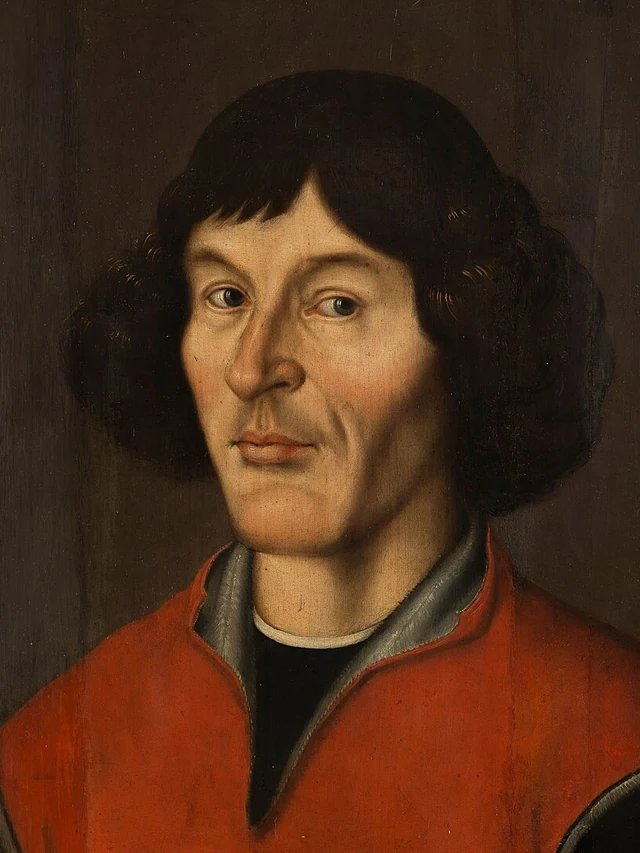

A life of discovery
The question they chased
Nicolaus Copernicus was born in 1473 in Toruń, in Poland. His father died when he was about ten, and his mother's brother, Lucas Watzenrode, who later became a bishop, took charge of his education. He studied in Kraków, Bologna, and Padua, and earned a doctorate in church law at Ferrara in 1503. He wanted to know why the planets seem to wander and how the heavens fit together.
Along the way he held a post as a canon in the cathedral chapter of Frombork. He worked out that the sky makes more sense if the Earth spins once a day and circles the Sun once a year. He wrote a short outline before 1514 and had largely finished his big book by about 1532. It was printed in 1543 as “On the Revolutions of the Heavenly Spheres.”
The big ideas
What Nicolaus figured out
Copernicus placed the Sun near the center and made Earth one planet among several. A daily spin explains why the Sun rises and sets. A yearly trip around the Sun explains why different stars show in different seasons.
Mars sometimes slows, loops backward, then moves forward again. If the Earth is moving, that is easy to explain. It is like passing a slower car on a highway. The other car seems to slide backward though it is still moving forward.
He still used perfect circles and small extra circles called epicycles. The Sun was near the center, not exactly at it. Later, Kepler found that planets move in ellipses. Copernicus got the big picture and left the details for others.
Key moments
How it unfolded
- 1473He is born in Toruń.
- 1503He earns a doctorate in church law at Ferrara.
- Before 1514He writes a short outline of his Sun-centered idea, the “Commentariolus.”
- 1539The young mathematician Georg Joachim Rheticus arrives and urges him to publish.
- 1543“On the Revolutions of the Heavenly Spheres” is printed.
- 1543Copernicus dies on 24 May at age 70 in Frombork.
The person behind the science
The patient man behind the book
Copernicus waited a long time. He had largely finished his book by about 1532 and did not publish until 1543. Historians give several reasons. The work needed long observations and heavy math. His church duties took time. Fog in Frombork made it hard to watch the sky. His numbers still had inconsistencies, and he lived far from any big printer. Fear of the church is described by one scholar as probably the least of his reasons. We cannot know how he felt. A raid in January 1520 likely destroyed instruments at Frombork. He kept working.
His uncle raised him and shaped his career. In 1539 Rheticus arrived, a visitor who encouraged him, wrote the first public report on his ideas in 1540, and oversaw much of the printing. His friend Tiedemann Giese stood up with Rheticus against the unsigned preface. Copernicus also worked as a doctor, and in 1541 he traveled to Königsberg to treat a counselor of Duke Albert, who recovered. He gave his life to ordinary duties and one extraordinary idea at the same time.
Small things that make them human
- Raised by an uncleAfter his father died, Lucas Watzenrode guided his schooling and career.
- Doctor as wellHe treated people in his chapter, and in 1541 he helped a patient in Königsberg recover.
- Defender of a castleHe directed the defense of Olsztyn during the war of 1519 to 1521.
- A preface he did not writeOsiander added unsigned words that went against the book, and Copernicus's friends protested.
A few surprising facts
Did you know
In 1526 he wrote a treatise on money and coins that contains an early form of what later became Gresham's law.
During a war in 1519 to 1521 he directed the defense of Olsztyn and the region of Warmia.
The printed book opened with an unsigned preface, written by Andreas Osiander, which said the Sun-centered idea was only a calculating trick. Copernicus did not write it. Rheticus crossed it out in his own copy.
A popular story says he woke from a stroke, held the finished book, and died. Historians call it a legend.
Why it still matters
What this means for you
Copernicus shows that a new idea can take decades of slow, careful work. He did not have a telescope. He had patience, math, and old observations. He also shows that scientists build on one another. Rheticus pushed him to publish, Kepler later corrected his circles, and Galileo gave new evidence. If you ever feel slow, remember that some of the biggest ideas in history needed years of quiet work.
Slow work can still change everything.
CURIOSITY ✦ RIGOR ✦ DISCOVERYTalk about it
Questions for your table
- Copernicus waited years before he published. When is it wise to wait, and when is it better to share your work?
- His friends stood up for his book when someone changed it. How can you stand up for a friend's work?
- He was wrong about circles but right about the big picture. How do you handle being partly right?
Try it today
Three small steps
- Notice: Watch the Moon or a bright planet at the same hour for three nights and write down where it is.
- Question: Ask why a car beside you seems to move backward when you pass it.
- Test: Have a friend walk slowly across a room while you walk faster along a parallel line and note when they appear to slide backward.