
BIOLOGY · OBSERVATION · LOGIC
Aristotle
The Man Who Counted the Animals
He lost his parents young, then spent two years on an island watching fish, bees, and birds to learn how life works.
- 384 BC to 322 BC
- Greece
- Life science
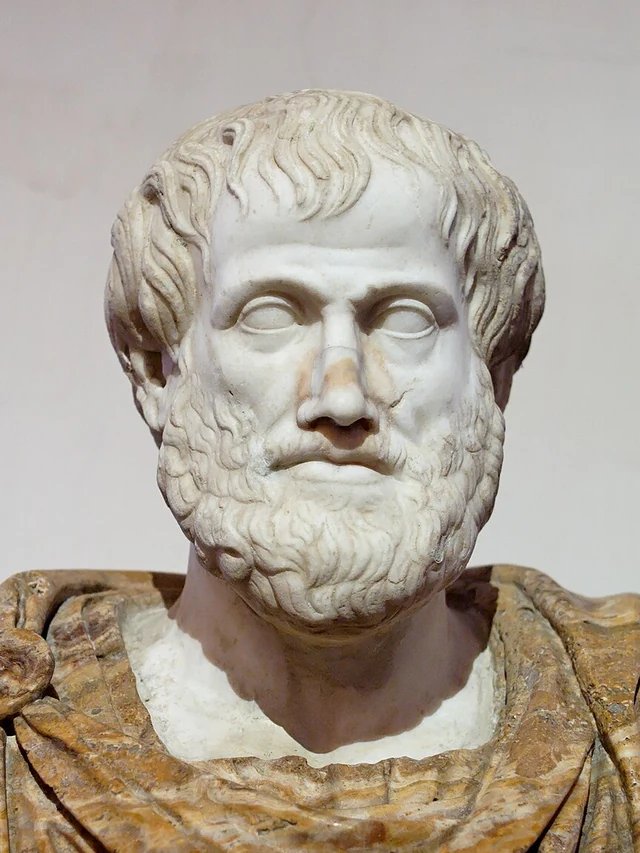

A life of discovery
The question they chased
Aristotle was born in 384 BC in Stagira, a small Greek town in the north. Both of his parents died while he was young, and a guardian named Proxenus raised him. At 17 or 18 he went to Athens to study with Plato, and he stayed nearly twenty years. He wanted to know what living things are made of, how they grow, and how a person can be sure of an answer.
Later he spent about two years studying animals on the island of Lesbos and its seas. He looked for himself and also asked fishermen, beekeepers, and travellers. He told apart about 500 kinds of animals and sorted them by shared features. In his book on animal reproduction he describes opening a fertilized hen's egg to watch the tiny heart of the embryo beat.
The big ideas
What Aristotle figured out
Aristotle gathered facts about real animals before he wrote theories. He cut open animals and watched them breed and grow. Today we call that collecting evidence, though he did not run experiments the way scientists do now.
He grouped animals by features such as how they are born and what covers their bodies. Then he noted the exceptions, like a shark that nourishes its young through a placenta. A good sorting system should admit what does not fit.
He believed heavier objects fall faster and that a vacuum cannot exist. Both ideas were later overturned. He also never proposed that species change over time. His mistakes gave later thinkers something to test.
Key moments
How it unfolded
- 384 BCHe is born in Stagira, in northern Greece.
- About 367 BCHe joins Plato's school in Athens at 17 or 18.
- 348 or 347 BCPlato dies and Aristotle leaves Athens for Assos, where he marries Pythias.
- 343 or 342 BCHe is invited to Pella to teach the young Alexander, later called Alexander the Great.
- 335 BCHe begins teaching at the Lyceum in Athens.
- 322 BCHe leaves Athens for his mother's family land in Chalcis and dies there of natural causes.
The person behind the science
The orphan who became a teacher
Aristotle did not leave diaries about his feelings, so we can only read his life. He lost both parents when young. He gave nearly twenty years to Plato's school and left when Plato died. A later tradition says he was disappointed that another man took over the school, but that is only tradition. His wife Pythias died in Athens. In 322 BC anti-Macedonian anger was strong in the city after Alexander's death, and someone accused Aristotle of impiety. He left rather than face it, and he died that year.
He did not go through it alone. Hermias, a ruler and former Academy member, was his friend, and Aristotle married Pythias, Hermias's niece and adopted daughter. Later he had a son, Nicomachus, with a woman named Herpyllis. Historians disagree about her exact status. His most productive writing years ran from 335 to 323 BC. Work was how he kept going. A will attributed to him survives in a later ancient biography. It names a trusted friend, Antipater, to carry it out and asks to be buried next to his wife.
Small things that make them human
- Raised by a guardianAfter his parents died, Proxenus of Atarneus took charge of him. That is the record. Anything more is guesswork.
- A famous line, maybeHe is said to have told Athens he would not let it sin twice against philosophy. It is an old tale, not a proven quote.
- A friend on the roadXenocrates, another student of Plato, went with him to Assos.
- Followers called PeripateticsHis school was called the Peripatetic school, a name that probably comes from the covered walkway at the Lyceum.
A few surprising facts
Did you know
He described the special arm that a male octopus uses in reproduction. Many scientists did not believe him for more than two thousand years, until the 1800s proved him right.
He was not a citizen of Athens. As a foreign resident he could not own property, so he rented the Lyceum grounds for his school.
How long he taught Alexander is debated. Estimates run from two or three years to as many as eight.
Ancient tradition says his family traced its roots to Asclepius, the Greek god of healing. It is a family tradition, not a proven fact.
Why it still matters
What this means for you
Aristotle reminds a student that real learning starts with careful looking. He watched, counted, and compared long before anyone called that science. He also reminds us that smart people are wrong sometimes, and being corrected is part of how knowledge grows. Every time you sort rocks, plants, or insects into groups, you are using a habit he helped start.
Look closely. Then ask why.
CURIOSITY ✦ RIGOR ✦ DISCOVERYTalk about it
Questions for your table
- Aristotle asked fishermen and beekeepers for facts. Who in your town knows something about nature that you could learn from?
- Some of his ideas were wrong for centuries. How should we treat a great thinker who made mistakes?
- He lost his parents young and kept working. What helps a person keep going when life gets hard?
Try it today
Three small steps
- Notice: Watch one insect or bird for five minutes and write down everything it does.
- Question: Pick five living things and decide the best way to sort them into two groups.
- Test: Find one creature that does not fit your groups and decide what that says about your system.