
Lecture VIII
The History of a Piece of Coal
I have here a piece of coal (Fig. 45), which, though it has been cut with some care so as to have a smooth face, is really in no other way different from any ordinary lump which you can
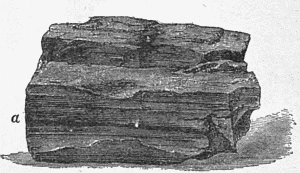 Fig. 45.—Piece of coal.
a, Smooth face, showing laminæ or thin layers.
It looks uninteresting enough at first sight, and yet if we examine it closely we shall find some questions to ask even about its appearance. Look at the smooth face of this specimen and see if you can explain those fine lines which run across so close together as to look like the edges of the leaves of a book. Try to break a piece of coal, and you will find that it will split much more easily along those lines than across the other way of the lump; and if you wish to light a fire quickly you should always put this lined face downwards so that the heat can force its way up through these cracks and gradually split up the block. Then again if you break the coal carefully along one of these lines you will find a fine film of charcoal lying in the crack, and you will begin to suspect that this black coal must have been built up in
The next thing you will call to mind is that this coal burns and gives flame and heat, and that this means that in some way sunbeams are imprisoned in it; lastly, this will lead you to think of plants, and how they work up the strength of the sunbeams into their leaves, and hide black carbon in even the purest and whitest substance they contain.
Is coal made of burnt plants, then? Not burnt ones, for if so it would not burn again; but you may have read how the makers of charcoal take wood and bake it without letting it burn, and then it turns black and will afterwards make a very good fire; and so you will see that it is probable that our piece of coal is made of plants which have been baked and altered, but which have still much sunbeam strength bottled up in them, which can be set free as they burn.
If you will take an imaginary journey with me to a coal-pit near
Newcastle, which I visited many years ago, you will see that we have
very good evidence that coal is made of plants, for in all coal-mines we
find remains of them at every step we take.
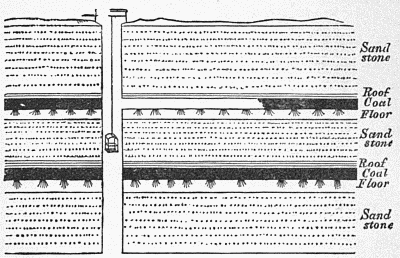 Fig. 46.—Imaginary section of a coal-mine.
Let us imagine that we have put on old clothes which will not spoil, and
have stepped into the iron basket (see Fig. 46) called by the miners a
cage, and are being let down the shaft to the gallery where the miners
are at work. Most of them will probably be in the gallery b, because a
great deal of the coal in a has been already taken out. But we will
stop in a because there we can see a great deal of the roof and theferns (a), for
they look like those you gather in the hedges of an ordinary country
lane, and that long striped branch (b) does not look unlike a reed,
and indeed it is something of this kind, as we
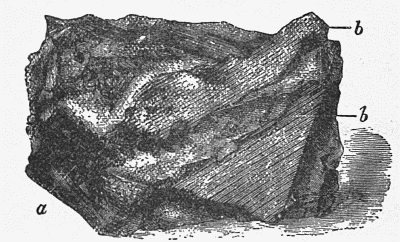 Fig. 47.—A piece of shale with impressions of ferns and Calamite stems.
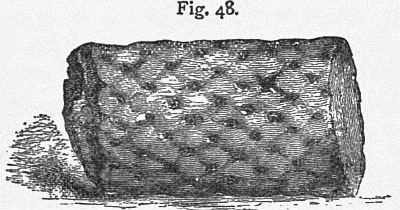 Gig. 48.—Stigmaria—root or underground stem of Sigillaria.
Next look down at your feet and examine the floor. You will not have to search long before you will almost certainly find a piece of stone like that represented in Fig. 48, which has also come from Neath[17] This fossil, which is the cast of a piece of a plant, puzzled those who found it for a very long time. At last, however, Mr. Binney found the specimen growing to the bottom of the trunk of one of the fossil trees with spotted stems, called Sigillaria; and so proved that this curious pitted stone is a piece of fossil root, or rather underground stem, like that which we found in the primrose, and that the little pits or dents in it are scars where the rootlets once were given off.
Whole masses of these root-stems, with ribbon-like roots lying scattered near them, are found buried in the layer of clay called the underclay which makes the floor of the coal, and they prove to us that this underclay must have been once the ground in which the roots of the coal-plants grew. You will feel still more sure of this when you find that there is not only one straight gallery of coal, but that galleries branch out right and left, and that everywhere you find the coal lying like a sandwich between the floor and the roof, showing that quite a large piece of country must be covered by these remains of plants all rooted in the underclay.
But how about the coal itself? It seems likely, when we find roots below and leaves and stems above, that the middle is made of plants, but can we prove it? We shall see presently that it has been so crushed and altered by being buried deep in the ground that the traces of leaves have almost been
But fortunately for us, perfect pieces of plants have been preserved even in the coal-bed itself. Do you remember our learning in Lecture IV. that water with lime in it petrifies things, that is, leaves carbonate of lime to fill up grain by grain the fibres of an animal or plant as the living matter decays, and so keeps an exact representation of the object?
Now, it so happens that in a coal-bed at South Ouram, near Halifax, as
well as in some other places, carbonate of lime trickled in before the
plants were turned into coal, and made some round nodules in the
plant-bed, which look like cannon-balls. Afterwards, when all the rest
of the bed was turned into coal, these round balls remained
crystallized, and by cutting thin transparent slices across the nodule
we can distinctly see the leaves and stems and curious little round
bodies which make up the coal. Several such sections may be seen at the
British Museum, and when we compare these fragments of plants with those
which we find above and below the coal-bed, we find that they agree,
thus proving that coal is made of plants, and of those plants whose
roots grew in the clay floor, while their heads reached up far above
where the roof now is.
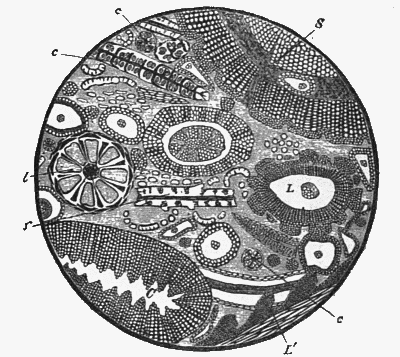 Fig. 49.—Contents of a coal-ball. (Carruthers.)[18]
S, Stem of Sigillaria cut across.
L, Stem of Lepidodendron cut
across.
L', Stem of Lepidodendron cut lengthways.
l, cone of
Lepidodendron (Lepidostrobus) cut across.
C, Stem of Calamite cut
across.
c,c,c, Fruit of Calamite lengthways and across.
f,
Stem of a fern with fragments of fern-leaves scattered round it.
The
small round dots scattered here and there are the larger
spores which
have fallen out of the fruit-cones.
The next question is, what kind of plants were these? Have we anything
like them living in the world now? You might perhaps think that it would
be impossible to decide this question from mere petrified pieces of
plants. But many men have spentc c and the little round
spores lying near them tell him their history as well as if he had
gathered them from the tree. In this way we have learnt to know very
fairly what the plants of the coal were like, and you will be surprised
when I tell you that the huge trees of the coal-forests, of which we
sometimes find trunks in the coal-mines from ten to fifty feet long, are
only represented on the earth now by small insignificant plants,
scarcely ever more than two feet, and often not many inches high.
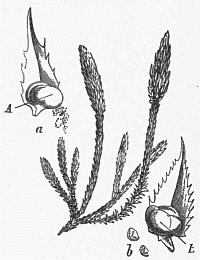 Fig. 50.—Selaginella selaginoides. Species of club-moss bearing two kinds of
spores.
Have you ever seen the little club-moss or Lycopodium which grows all over England, but chiefly in the north, on heaths and mountains? At the end of each of its branches it bears a cone made of scaly leaves; and fixed to the inside of each of these leaves is a case called a sporangium, full of little spores or moss-seeds, as we may call them, though they are not exactly like true seeds. In one of these club-mosses called Selaginella, the cases B near the bottom of the cone contain large spores b, while those near the top A, contain aa. These spores are full of resin, and they are collected on the Continent for making artificial lightning in the theatres, because they flare when lighted.
Now this little Selaginella is of all living plants the one most like some of the gigantic trees of the coal-forests. If you look at this picture of a coal-forest (Fig. 51), you will find it difficult perhaps to believe that those great trees, with diamond markings all up the trunk, hanging over from the right to the left of the picture, and covering all the top with their boughs, could be in any way relations of the little Selaginella; yet we find branches of them in the beds above the coal, bearing cones larger but just like Selaginella cones; and what is most curious, the spores in these cones are of exactly the same kind and not any larger than those of the club-moss.
These trees are called by botanists Lepidodendrons, or scaly trees;
there are numbers of them in all coal-mines, and one trunk has been
found 49 feet long. Their branches were divided in a curious forked
manner and bore cones at the ends. The spores which fell from these
cones are found flattened in the coal, and they may be seen scattered
about in the coal-ball (Fig. 49).
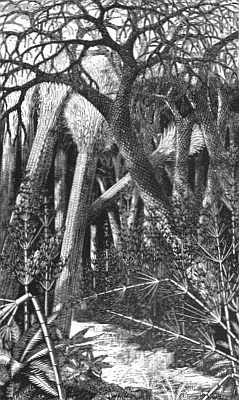 Fig. 51.—A FOREST OF THE COAL PERIOD.
Another famous tree which grew in the coal-forests was the one whose
roots we found in the floor or underclay of the coal. It has been
called Sigillaria, because it has marks like seals (sigillum, a seal)
all up the trunk, due to the scars left by the leaves when they fell
from the tree. You will see the Sigillarias on the left-hand side of the
coal-forest picture, having those curious tufts of leaves springing out
of them at
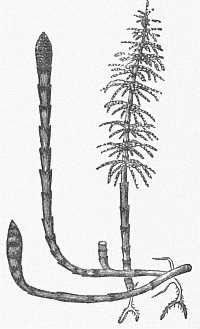 Fig. 52.—Equisetum or horsetail.
But what is that curious reed-like stem we found in the piece of shale (see Fig. 47)? That stem is very important, for it belonged to a plant called a Calamite, which, as we shall see presently, helped to sift the earth away from the coal and keep it pure. This plant was a near relation of the "horsetail," or Equisetum, which grows in our marshes; only, just as in the case of the other trees, it was enormously larger, being often
These great trees, the Lepidodendrons, the Sigillarias, and the Calamites, together with large tree-ferns and smaller ferns, are the chief plants that we know of in the coal-forests. It seems very strange at first that they should have been so large when their descendants are now so small, but if you look at our chief plants and trees now, you will find that nearly all of them bear flowers, and this is a great advantage to them, because it tempts the insects to bring them the pollen-dust, as we saw in the last lecture.
Now the Lepidodendrons and their companions had no true flowers, but only these seed-cases which we have mentioned; but as there were no flowering plants in their time, and they had the ground all to themselves, they grew fine and large. By-and-by, however, when the flowering plants came in, these began to crowd out the old giants of the coal-forests, so that they dwindled and dwindled from century to century till their great-great-grandchildren, thousands of generations after, only lift up their tiny heads in marshes and on heaths, and tell us that they were big once upon a time.
And indeed they must have been magnificent in
And now, if you have some idea of the plants and trees of the coal, it is time to ask how these plants became buried in the earth and made pure coal, instead of decaying away and leaving behind only a mixture of earth and leaves?
To answer this question, I must ask you to take another journey with me across the Atlantic to the shores of America, and to land at Norfolk in Virginia, because there we can see a state of things something like the marshes of the coal-forests. All round about Norfolk the land is low, flat, and marshy, and to the south of the town, stretching far away into North Carolina, is a large, desolate swamp, no less than forty miles long and twenty-five broad. The whole place is one enormous quagmire, overgrown with water-plants and trees. The soil is as black as ink from the old, dead leaves, grasses, roots, and stems
The whole place is so still, gloomy, and desolate, that it goes by the name of the "Great Dismal Swamp," and you see we have here what might well be the beginning of a bed of coal; for we know that peat when dried becomes firm and makes an excellent fire, and that if it were pressed till it was hard and solid it would not be unlike coal. If, then, we can explain how this peaty bed has been kept pure from earth, we shall be able to understand how a coal-bed may have been formed, even though the plants and trees which grow in this swamp are different from those which grew in the coal-forests.
The explanation is not difficult; streams flow constantly, or rather ooze into the Great Dismal Swamp from the land that lies to the west, but instead of bringing mud in with them as rivers bring to the sea, they bring only clear, pure water, because, as they filter for miles through the dense jungle of reeds, ferns, and shrubs which grow round the marsh, all the earth is sifted out and left behind. In this way the spongy mass of dead plants remains free from earthy grains, while the water and the shade of the thick forest of trees prevent the leaves, stems,
Now we know that there were plenty of ferns and of large Calamites growing thickly together in the coal-forests, for we find their remains everywhere in the clay, so we can easily picture to ourselves how the dense jungle formed by these plants would fringe the coal-swamp, as the present plants do the Great Dismal Swamp, and would keep out all earthy matter, so that year after year the plants would die and form a thick bed of peat, afterwards to become coal.
The next thing we have to account for is the bed of shale or hardened clay covering over the coal. Now we know that from time to time land has gone slowly up and down on our globe so as in some places to carry the dry ground under the sea, and in others to raise the sea-bed above the water. Let us suppose, then, that the great Dismal Swamp was gradually to sink down so that the sea washed over it and killed the reeds and shrubs. Then the streams from the west would not be sifted any longer but would bring down mud, and leave it, as in the delta of the Nile or Mississippi, to make a layer over the dead plants. You will easily understand that this mud would have many pieces of dead trees and plants in it, which were stifled and died as it covered them over; and thus the
But still there are the thick sandstones in the coal-mine to be explained. How did they come there? To explain them, we must suppose that the ground went on sinking till the sea covered the whole place where once the swamp had been, and then sea-sand would be thrown down over the clay and gradually pressed down by the weight of new sand above, till it formed solid sandstone and our coal-bed became buried deeper and deeper in the earth.
At last, after long ages, when the thick mass of sandstones above the bed b (Fig. 46, p. 174) had been laid down, the sinking must have stopped and the land have risen a little, so that the sea was driven back; and then the rivers would bring down earth again and make another clay-bed. Then a new forest would spring up, the ferns, Calamites, Lepidodendrons, and Sigillarias would gradually form another jungle, and many hundreds of feet above the buried coal-bed b, a second bed of peat and vegetable matter would begin to accumulate to form the coal-bed a.
Such is the history of how the coal which we now dig out of the depths of the earth once grew as beautiful plants on the surface. We cannot tell exactly all the ground over which these forests grew in England, because some of the coal they made has been carried away since by rivers and cut down by the waves of the sea, but we can say that wherever there is coal now, there they must have been.
Try and picture to yourselves that on the east coast
But what is it that has changed these beds of dead plants into hard, stony coal? In the first place you must remember they have been pressed down under an enormous weight of rocks above them. We can learn something about this even from our common lead pencils. At one time the graphite or pure carbon, of which the blacklead (as we wrongly call it) of our pencils is made, was dug solid out of the earth. But so much has now been used that they are obliged to collect the graphite dust, and press it under a heavy weight, and this makes such solid pieces that they can cut them into leads for ordinary cedar pencils.
Now the pressure which we can exert by machinery is absolutely nothing compared to the weight of all those hundreds of feet of solid rock which lie over the coal-beds, and which has pressed them down for thousands and perhaps millions of years; and besides this, we know that parts of the inside of the earth are very hot, and many of the rocks in which coal is found are altered by heat. So we can picture to ourselves that the coal was not only squeezed into a solid mass, but often much of the oil and gas which were in the leaves of the plants was driven out by heat, and the whole baked, as it were, into one substance. The difference between coal which flames and coal which burns only with a red heat, is chiefly that one has been baked and crushed more than the other. Coal which flames has still got in it the tar and the gas and the oils which the plant stored up in its leaves, and these when they escape again give back the sunbeams in a bright flame. The hard stone coal, on the contrary, has lost a great part of these oils, and only carbon remains, which seizes hold of the oxygen of the air and burns without flame. Coke is pure carbon, which we make artificially by driving out the oils and gases from coal, and the gas we burn is part of what is driven out.
We can easily make coal-gas here in this room. I have brought a
tobacco-pipe, the bowl of which is filled with a little powdered coal,
and the broad end cemented up with common clay. When we place this bowl
over a spirit-lamp and make it very hot, the gas is driven out at the
narrow end of the pipe and lights easily (see Fig. 53). This is the way
all our gas
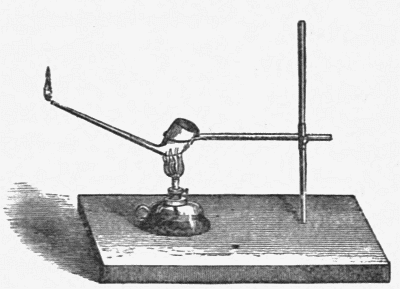 Fig. 53.
You will find it difficult at first to understand how coal can be so full of oil and tar and gases, until you have tried to think over how much of all these there is in plants, and especially in seeds—think of the oils of almonds, of lavender, of cloves, and of caraways; and the oils of turpentine which we get from the pines, and out of which tar is made. When you remember these and many more, and also how the seeds of the club-moss now are largely charged with oil, you will easily imagine that the large masses of coal-plants which have been pressed together and broken and crushed, would give out a great deal of oil which, when made very hot, rises up as gas. You may often yourself see tar oozing out of the lumps of coal in a fire, and making little black bubbles which burst and burn. It is from this tar that James Young first made the paraffin oil we burn in our lamps, and the spirit benzoline comes from the same source.
From benzoline, again, we get a liquid called aniline, from which are made so many of our beautiful dyes—mauve, magenta, and violet; and what is still more curious, the bitter almonds, pear-drops, and many other sweets which children like so well, are actually flavoured by essences which come out of coal-tar. Thus from coal we get not only nearly all our heat and our light, but beautiful colours and pleasant flavours. We spoke just now of the plants of the coal as being without beautiful flowers, and yet we see that long, long after their death they give us lovely colours and tints as beautiful as any in flower-world now.
Think, then, how much we owe to these plants which lived and died so long ago! If they had been able to reason, perhaps they might have said that they did not seem of much use in the world. They had no pretty flowers, and there was no one to admire their beautiful green foliage except a few croaking reptiles, and little crickets and grasshoppers; and they lived and died all on one spot, generation after generation, without seeming to do much good to anything or anybody. Then they were covered up and put out of sight, and down in the dark earth they were pressed all out of shape and lost their beauty and became only black, hard coal. There they lay for centuries and centuries, and thousands and thousands of years, and still no one seemed to want them.
At last, one day, long, long after man had been living on the earth, and had been burning wood for fires, and so gradually using up the trees in the forests,
Again, without coal we could have had no engines of any kind, and consequently no large manufactories of cotton goods, linen goods, or cutlery. In fact, almost everything we use could only have been made with difficulty and in small quantities; and even if we could have made them it would have been impossible to have sent them so quickly all over the world without coal, for we could have had no railways or steamships, but must have carried all goods along canals, and by slow sailing vessels. We ourselves must have taken days to perform journeys now made in a few hours, and months to reach our colonies.
In consequence of this we should have remained a very poor people. Without manufactories and industries we should have had to live chiefly by tilling the ground, and everyone being obliged to toil for
All this then, those plants and trees of the far-off ages, which seemed to lead such useless lives, have done and are doing for us. There are many people in the world who complain that life is dull, that they do not see the use of it, and that there seems no work specially for them to do. I would advise such people, whether they are grown up or little children, to read the story of the plants which form the coal. These saw no results during their own short existences, they only lived and enjoyed the bright sunshine, and did their work, and were content. And now thousands, probably millions, of years after they lived and died, England owes her greatness, and we much of our happiness and comfort, to the sunbeams which those plants wove into their lives.
They burst forth again in our fires, in our brilliant lights, and in our engines, and do the greater part of our work; teaching us
That not one life shall be destroyed,
Or cast as rubbish to the void,
When God hath made the pile complete."
In Memoriam, liv.
