
CHEMISTRY · GASES · EXPERIMENT
Robert Boyle
The Gentleman Who Made Chemistry Honest
He was born rich and his health was never strong. Robert Boyle taught chemists to test an idea before they believed it.
- 1627 to 1691
- Ireland and England
- Chemistry
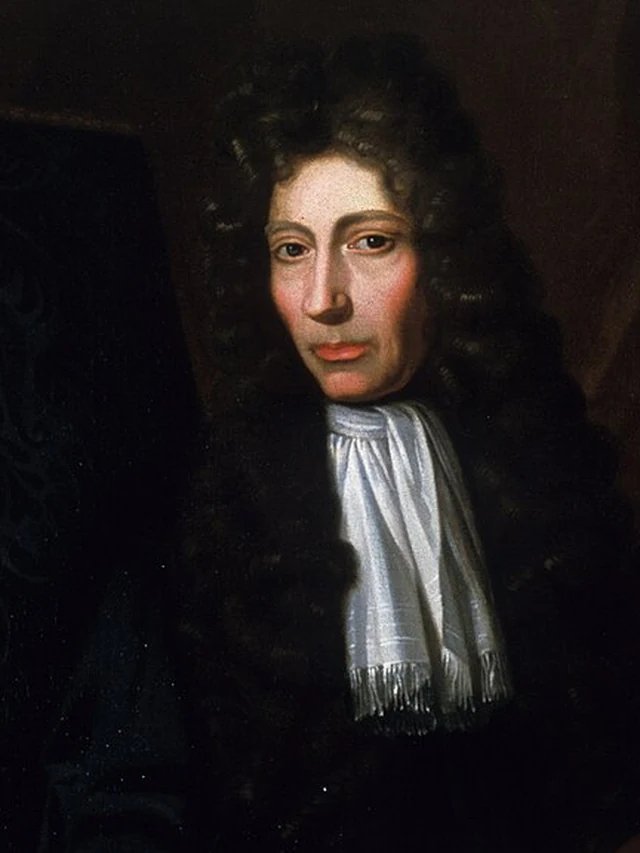

A life of discovery
The question they chased
Robert Boyle was born at Lismore Castle in Ireland on 25 January 1627. He was the seventh son and the fourteenth child of the Earl of Cork. His mother died when he was a small child. At about eight he and his brother Francis were sent to school at Eton. He later toured Europe with a tutor and spent the winter of 1641 in Florence, reading about the ideas of Galileo.
Boyle set up a laboratory at his home in Stalbridge, and in 1654 he moved to Oxford. There, with the help of Robert Hooke, he improved a vacuum pump so he could study air. His experiments on air were published in 1660, and a year later he wrote “The Sceptical Chymist.” In that book he asked chemists to stop repeating old claims and to show their evidence. He also described how the pressure of a gas changes when it is squeezed.
The big ideas
What Robert figured out
Boyle's law says that when the temperature stays the same, squeezing a gas into half the space doubles its pressure. Put your finger over the tip of a bicycle pump and push the handle. You feel the air push back harder and harder. Boyle first stated this in 1662 while answering critics, and he pointed to an earlier paper by Henry Power.
Boyle wrote that he did not like to believe things on guesswork when an experiment could settle the question. He ran experiments, wrote them out in detail, and told readers exactly how to repeat them. That way anyone could check him.
In his chemistry writing, Boyle separated mixtures from compounds. He also used the word analysis for finding out what a material is made of. Salt water is a mixture, and you can separate it by boiling off the water. That kind of careful sorting is still where lab work begins.
Key moments
How it unfolded
- 1627Robert is born at Lismore Castle in County Waterford on 25 January.
- 1641He spends the winter in Florence studying the ideas of Galileo.
- 1660His experiments with an improved air pump are published.
- 1661He publishes “The Sceptical Chymist.”
- 1680He is offered the presidency of the Royal Society and declines it.
- 1691He dies in London on 31 December.
The person behind the science
The gentle man in the laboratory
Boyle lost his mother when he was a small child, and at about eight he was sent away to school. His health was never strong, and it got much worse in 1669. After that he pulled back from public life.
His closest partner was his older sister, Katherine, Lady Ranelagh. In 1668 he moved into her home in Pall Mall in London. They shared a laboratory and a lively circle of thinkers for more than twenty years. When she died in December 1691, Boyle died a week later. He was a devout member of the Church of England, and his will paid for the Boyle Lectures, which defended the Christian faith.
Small things that make them human
- A brother at EtonAt about eight he and his brother Francis were sent off to Eton together.
- Principle over honorHe gave up two famous posts rather than go against his conscience.
- A generous giverHe spent large sums on Bible translations and on missions as a director of the East India Company.
- A shared houseHe and Katherine ran a lab and a salon under one roof in Pall Mall.
A few surprising facts
Did you know
He was the fourteenth child in his family.
He avoided dissections and vivisections because of what he called the tenderness of his nature.
He paid for the printing of the Bible in the Irish language between 1680 and 1685.
He turned down the Royal Society presidency because of a worry about taking an oath, and he turned down the head job at Eton because he would not become a clergyman.
Why it still matters
What this means for you
Boyle's law lives in every pump, syringe, and bicycle tire you use. His deeper gift was a habit. Write down exactly what you did so someone else can repeat it. Be honest about what you do not know. Boyle also shows that you can work from a hard place. His health was poor, and yet he built much of the modern way of doing chemistry from his own rooms.
Do not guess when you can test.
CURIOSITY ✦ RIGOR ✦ DISCOVERYTalk about it
Questions for your table
- Boyle wrote his experiments so that others could repeat them. Why is it a sign of honesty to let others check your work?
- He gave up two high honors because of his conscience. What would you be willing to give up to stay true to what you believe?
- Boyle and his sister Katherine worked side by side for more than twenty years. How has a partner or a family member helped you do something you could not do alone?
Try it today
Three small steps
- Notice: Push the plunger of a sealed syringe or a bicycle pump with your finger over the end and describe how the push changes as the air gets squeezed.
- Question: Write down one thing you have always been told is true and say what test would prove it.
- Test: Write step-by-step directions for a simple experiment so clearly that a friend can repeat it without asking you any questions.