
BIOLOGY · PRIMATES · CONSERVATION
Jane Goodall
The Woman Who Sat Still and Saw Chimpanzees as Individuals
A girl with a stuffed chimpanzee became a young woman in the African forest and changed how people see animals.
- 1934 to 2025
- United Kingdom and Tanzania
- Life science
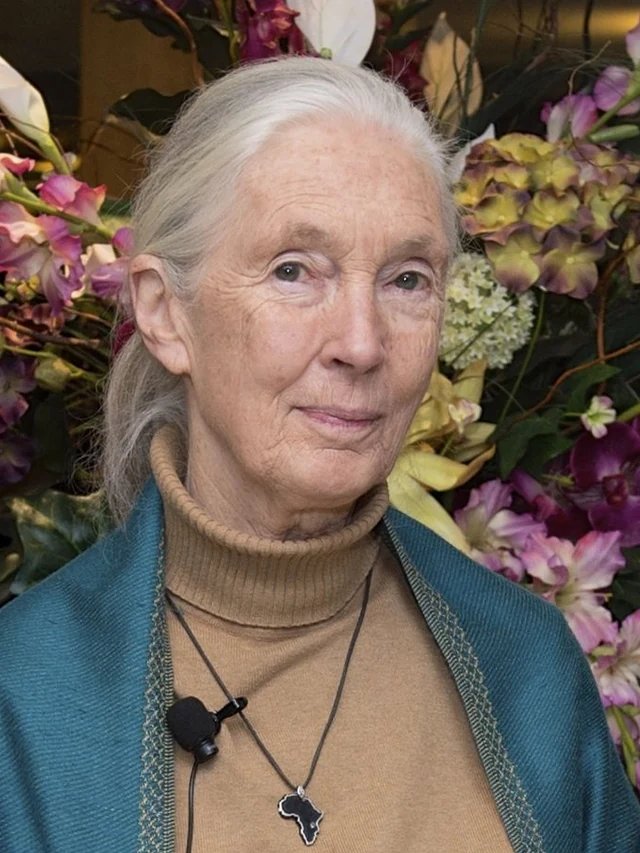

A life of discovery
The question they chased
Jane Goodall was born in London on April 3, 1934. As a child she was given a stuffed chimpanzee named Jubilee by her father. She left school at 18 and worked as a secretary. In 1957 she visited a friend's farm in Kenya and called the scientist Louis Leakey. She wanted to know how wild chimpanzees really live.
On July 14, 1960, she arrived at Gombe in what is now Tanzania. Her mother, Vanne, came along, partly to satisfy the chief warden's safety concerns. A male chimpanzee with a gray chin, called David Greybeard, was the first to warm up to her. In October 1960 she watched him push a grass stem into a termite mound and pull out termites. When Leakey heard, he said that science must redefine tool, redefine man, or accept chimpanzees as human.
The big ideas
What Jane figured out
Many people believed only humans made and used tools. Goodall watched chimpanzees strip leaves from twigs and use them to fish termites out of mounds. That showed tool use, and the beginnings of tool making, in a wild animal.
Goodall gave her subjects names, not numbers. She recorded their moods, friendships, and family bonds. Some scientists said that was not objective, but her long records showed that each chimpanzee has its own history and character.
From 1974 to 1978 she followed the Gombe Chimpanzee War, a conflict in which one community split in two and the groups fought for years. It was hard to see. It also shaped debate about where aggression comes from.
Key moments
How it unfolded
- 1957She visits Kenya and contacts Louis Leakey.
- 1960On July 14 she arrives at Gombe Stream, with her mother.
- 1960In October she sees David Greybeard use a grass stem as a tool.
- 1965She is awarded a PhD in ethology from Cambridge.
- 1977She founds the Jane Goodall Institute.
- 1991Roots & Shoots begins with twelve teenagers in Dar es Salaam.
The person behind the science
Patience, loss, and the choice to keep going
Goodall's life was not only forest and chimpanzees. She married the filmmaker Hugo van Lawick in 1964, and their son Hugo, called Grub, was born in 1967. They divorced in 1974, the same year the chimpanzee war began at Gombe. In 1975 she married Derek Bryceson. He died of cancer in October 1980. She did not hide the hard parts of chimpanzee life, and she described the war in her 1990 memoir.
She kept going by turning her work outward. In 1977 she founded the Jane Goodall Institute. In 1991 she started Roots & Shoots so that young people could lead projects in their own communities. She kept traveling to speak until the end of her life. She died on October 1, 2025, at age 91, of natural causes, while on a speaking tour in California.
Small things that make them human
- The first to trust herDavid Greybeard was the first chimpanzee to warm up to her.
- A mentor took a chanceLouis Leakey sent her to London in 1958 to study primates, and he arranged her Cambridge study in 1962.
- A mother's helpVanne Morris-Goodall came with her to Gombe in 1960.
- A family of her ownHer son Hugo was born in 1967 and was known as Grub.
A few surprising facts
Did you know
She entered Cambridge without a bachelor's degree. Leakey arranged her funding in 1962.
Some scientists said naming animals broke the rules of objective science. She named them anyway.
In 2002 she became a United Nations Messenger of Peace.
Roots & Shoots began with twelve teenagers and grew into a youth program for helping people, animals, and the environment.
Why it still matters
What this means for you
Goodall shows that patience can be a scientific tool. She sat still and watched, and she saw what quick looks missed. Her work changed how people think about animals and about our place among them. She also turned what she learned into action, because she believed each person's choices matter. A student does not need a degree to start paying close attention to the living world.
Sit still, watch closely, then act.
CURIOSITY ✦ RIGOR ✦ DISCOVERYTalk about it
Questions for your table
- Goodall had no college degree when she started, but she had patience. What skill do you have now that could take you somewhere?
- Other scientists criticized her for naming the chimpanzees. When have you done something your own way even though people doubted it?
- She lost her husband Derek in 1980 and kept helping others. What helps you or people you know through a loss?
Try it today
Three small steps
- Notice: Sit outside for fifteen minutes without your phone and write down every living thing you see or hear.
- Question: Pick one animal you see often, like a squirrel or a bird, and ask what it seems to want and how you know.
- Test: Watch the same animal at the same time on three different days and record what it does each time.