
PHYSICS · RELATIVITY · LIGHT
Albert Einstein
The Patent Clerk Who Bent Space and Time
He struggled to find work, lost people he loved, and still changed how we understand light, time, and gravity.
- 1879 to 1955
- Germany, Switzerland, and the United States
- Physics
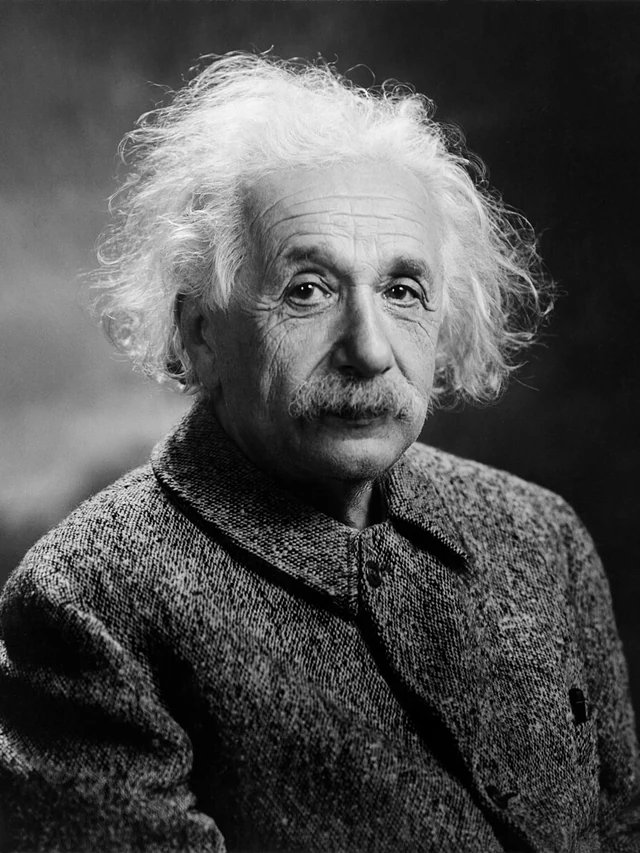

A life of discovery
The question they chased
Albert Einstein was born in Ulm, Germany, in 1879 and grew up in Munich. His parents worried that he was slow to talk. At about five he was sick in bed when his father gave him a compass. He was amazed that an invisible force could move the needle. He also began violin lessons then and did not like them at first. At thirteen he fell in love with Mozart's sonatas. At sixteen he took the entrance exam for a Swiss polytechnic school in Zurich and failed the general section, though he did very well in math and physics. He finished school in Aarau and graduated from the Zurich Polytechnic in 1900.
After graduation he spent almost two years looking for a teaching job. With help from the father of his friend Marcel Grossmann, he got a permanent post at the Swiss Patent Office in Bern in 1903. He kept thinking about physics while he worked there. In 1905 he published four papers that changed science. They covered light as packets of energy, the motion of tiny particles in water, a new theory of space and time, and the link between mass and energy.
The big ideas
What Albert figured out
Shine light on a metal and electrons can pop out. Einstein explained this in 1905 by saying light travels in small packets of energy. A dimmer light gives fewer packets, and each packet's energy depends on the color. This work, the photoelectric effect, is what won him the Nobel Prize.
Einstein started from one idea. The speed of light is the same for every observer. From that he showed that time and space change depending on how fast you move. A moving clock runs slow compared to one standing still. The effect is far too small to notice in daily life. He also found that mass and energy are linked, which is the meaning of E equals m c squared.
By 1916 Einstein had described gravity as the bending of space and time by mass. Think of a heavy ball on a stretched sheet. A smaller ball rolls toward it along the curve. In 1919 Arthur Eddington observed an eclipse and found that starlight bent near the Sun as Einstein predicted. Newspapers around the world reported it.
Key moments
How it unfolded
- 1903He starts a permanent job at the Swiss Patent Office in Bern.
- 1905He publishes four major papers, including special relativity.
- 1919Eddington's eclipse photographs match Einstein's prediction about bending starlight.
- 1921He is awarded the 1921 Nobel Prize in Physics, announced in 1922, for the photoelectric effect and not for relativity.
- 1933He gives up his German citizenship and later settles at Princeton in the United States.
- 1955He dies in Princeton, New Jersey.
The person behind the science
The man who played violin
Einstein's life had real hardship. He searched for work for almost two years. His daughter Lieserl was born in early 1902, and historians do not know what became of her. He and Mileva had two sons, Hans Albert and Eduard. They divorced in 1919. Eduard became seriously ill as a young man and was cared for in a hospital in Zurich. In 1936 his second wife, Elsa, died.
He found steadiness in music, friends, and work. He played chamber music, and near the end of his life he played with the Juilliard Quartet. He loved to sail. When the Nazis took power in 1933 he gave up his German citizenship, and his sailboat was taken from him. He built a new life at the Institute for Advanced Study in Princeton and kept working.
Small things that make them human
- A compass at fiveHis father's gift made him wonder about invisible forces for the rest of his life.
- Music to thinkHe disliked violin lessons at first but loved Mozart by age thirteen.
- A boat taken awayNazi authorities took his sailboat in 1933 and it was later sold.
- A letter he regrettedHe signed a 1939 letter urging the United States to study nuclear research. He later called it a mistake.
A few surprising facts
Did you know
Myth. People say Einstein failed math. He did not. In 1935 he laughed at a newspaper clipping that said so and answered, "I never failed in mathematics." He had learned calculus before he was fifteen.
What is true is that he did fail the general part of the entrance exam at sixteen. He was strong in math and physics.
His Nobel Prize was not for relativity. It was for his work on the photoelectric effect.
In 1952 he was offered the presidency of Israel. He said no.
Why it still matters
What this means for you
Einstein shows that being a slow starter or failing one test does not decide who you are. He kept asking odd questions, like what it would be like to ride alongside a beam of light, and he followed them for years. His ideas now reach everyday life. GPS satellites must correct for the way time runs a little differently high above Earth. The story of his life is also a reminder that hard times and a curious mind can live in the same person.
Keep asking the strange question.
CURIOSITY ✦ RIGOR ✦ DISCOVERYTalk about it
Questions for your table
- Einstein did not get a teaching job for almost two years. What do you do when your plans do not work out right away?
- People tell a false story that he failed math. Why do you think myths like that spread so easily?
- Music helped him think. What do you do that clears your head and helps you solve problems?
Try it today
Three small steps
- Notice: Next time you ride in a car or bus, watch objects outside and write down how their motion depends on where you are sitting.
- Question: Ask what it means to say something is moving or standing still.
- Test: Roll a ball inside a smoothly moving vehicle and see whether you can tell if you are moving without looking outside.