
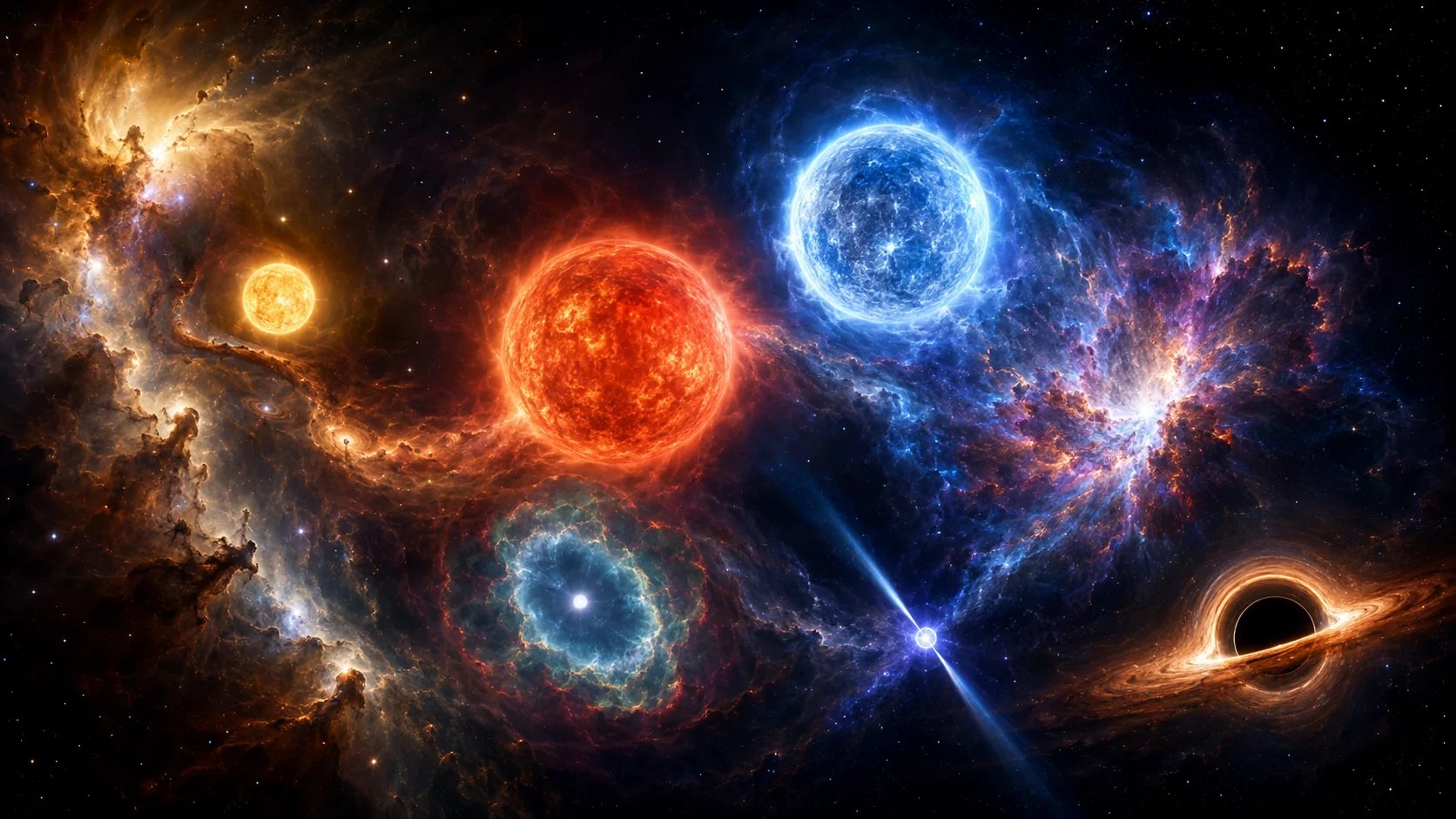
A star begins in a cold molecular cloud. Gravity gathers gas into a protostar until the core becomes hot and dense enough for hydrogen fusion. For most of the star’s life, inward gravity and outward pressure reach a dynamic balance called hydrostatic equilibrium.
A Sun-like star eventually exhausts core hydrogen, expands into a red giant, sheds its outer layers as a planetary nebula, and leaves an Earth-sized white dwarf. Our Sun is not massive enough to become a neutron star or black hole.
A much more massive star fuses heavier elements in successive stages. When an iron-rich core can no longer supply supporting energy, the core collapses and the outer star can explode as a supernova. The crushed remnant may become a neutron star—a city-sized object containing more mass than the Sun—or, if the collapsing core is massive enough, a black hole.
Neutron-star matter is so dense that a teaspoon is commonly estimated to weigh around a billion tons on Earth. That is an order-of-magnitude illustration, not material we could actually scoop: outside the star’s immense pressure it would not remain a stable spoonful. The startling estimate comes from packing stellar mass into a sphere only tens of kilometers wide.