
Brothers LearningFREE LESSONS FOR EVERY CLASSROOM
Brothers Learningany school district
← All Science TalesMR. BOUYER SCIENCETALE 17 OF 20

Physics • IPC • Astronomy • SCIENCE TALE 17

How Big Can a Star Become?

A ruler-changing journey from a school building to the largest known stellar candidatesEnter the story ↓

BEGIN WITH THE ORDINARY

Look again.
Something remarkable is hiding here.

If the Sun were placed beside the largest stars we can measure, it would shrink from a blazing giant into a nearly invisible point. But before that comparison makes sense, our ruler must change again and again.
17

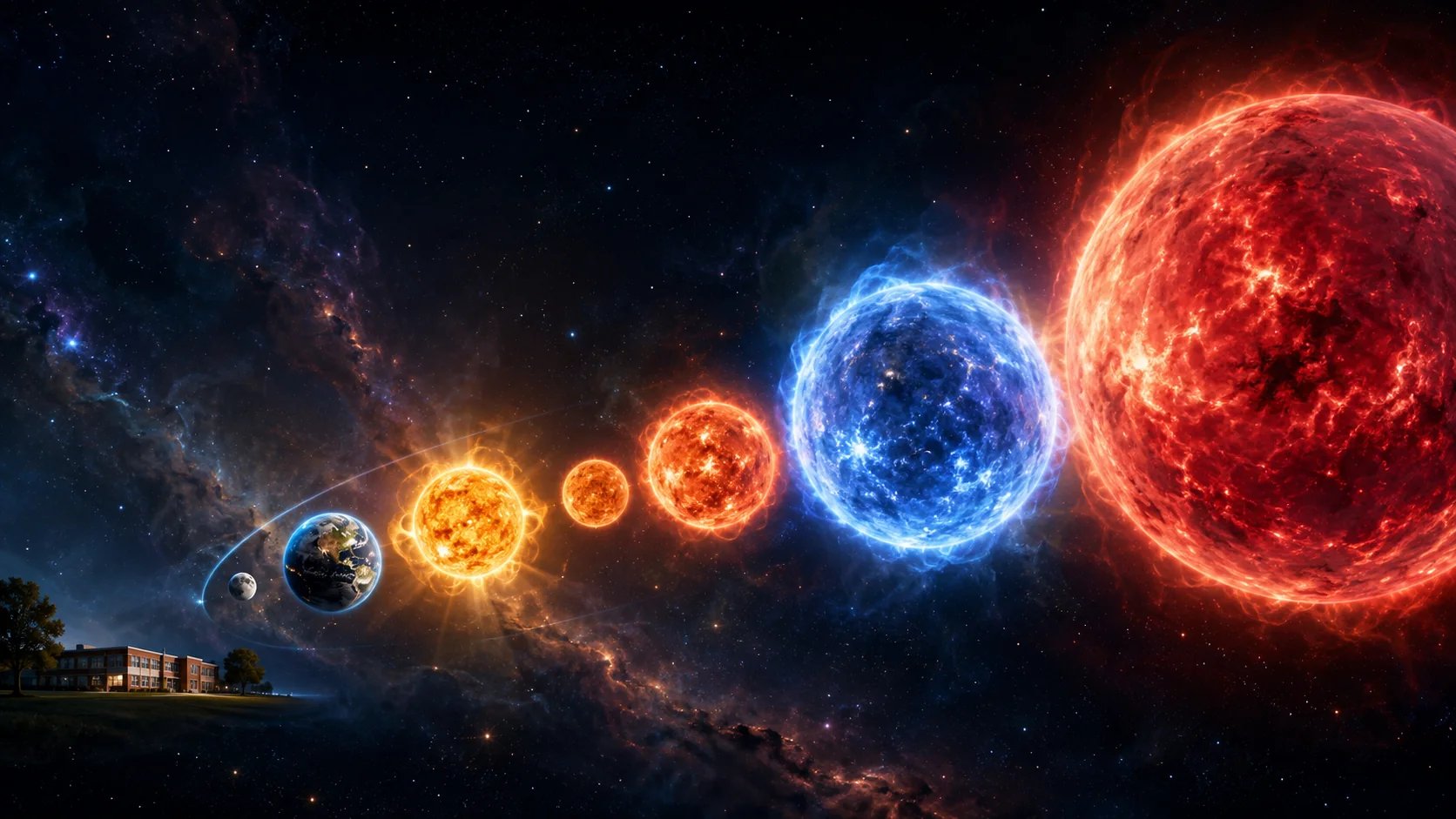
Begin beside a thirty-meter school building. The Moon is about 3,475 kilometers across and Earth about 12,742 kilometers. The Sun spans roughly 1.39 million kilometers—about 109 Earths laid edge to edge. No single ordinary drawing can show the building and Sun honestly at once.

Now use the Sun itself as the ruler. Sirius A is less than twice the Sun’s radius. Pollux and Arcturus are giants measured in many solar radii. Aldebaran and Rigel are larger still. Betelgeuse is a red supergiant with a diffuse, changing atmosphere: its edge is not a crisp painted line.

At the far end are red supergiants and hypergiants such as VY Canis Majoris, UY Scuti, WOH G64, and candidates in the Stephenson 2 cluster. Estimates can reach roughly one thousand to more than two thousand solar radii, but the numbers are model-dependent. Dust, pulsation, distance, wavelength, and the definition of an edge can change the ranking.

That uncertainty is part of the tale. Science does not merely announce a biggest star; it measures light, distance, temperature, and angular size, builds a model, reports uncertainty, and revises the leaderboard when the evidence improves.

01

Solar radius

Astronomers use the Sun’s radius—about 696,000 kilometers—as a convenient stellar ruler.

02

Repeated zoom

A building-to-hypergiant comparison needs several scale changes; one linear picture would hide nearly everything.

03

Uncertain edges

A giant star’s atmosphere can pulse and fade gradually into space, so its quoted radius depends on observations and models.

INTERACTIVE MODEL

Change one thing.
Watch the system answer.

SunSirius APolluxArcturus
STOP 7 OF 12 • GIANT STARArcturus≈25 Sun radii
THE SCIENCE BENEATH THE STORY

Scale is not just a number. Every honest cosmic comparison must say what ruler is being used—and how certain the measurement is.

BRING IT BACK TO THE ROOM

Questions worth
slowing down for.

  1. 01Why can’t one ordinary linear diagram show a building, Earth, the Sun, and a hypergiant clearly?
  2. 02What makes the edge of a red supergiant difficult to define?
  3. 03Why might the list of largest known stars change?
  4. 04How many Earth diameters fit across the Sun?
MR. BOUYER’S SCIENCE TALES

The ordinary world
is not ordinary at all.

Choose another tale →