
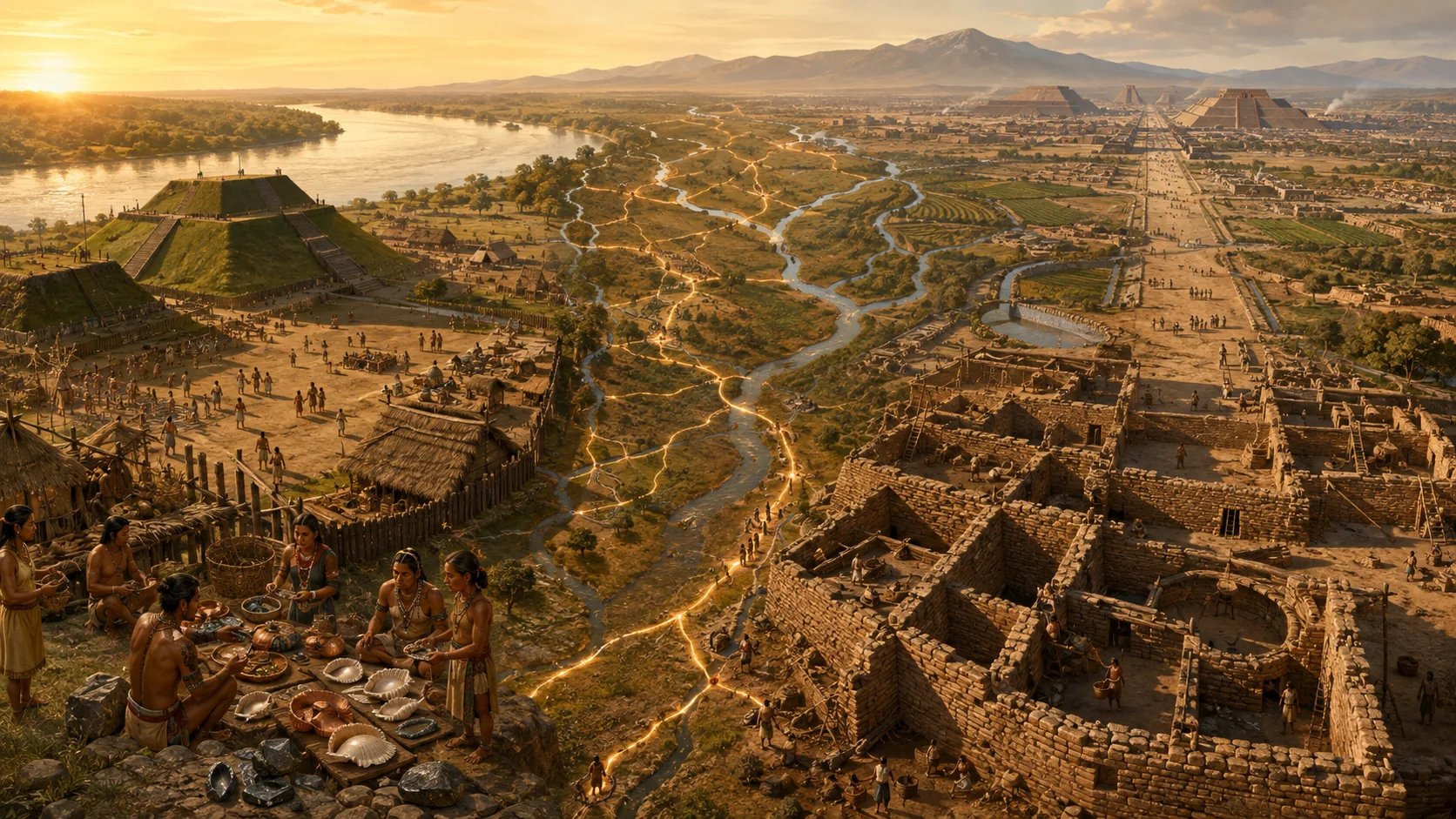
Begin at Cahokia, near present-day St. Louis. Around 1050–1200 CE it was the largest known urban center north of Mexico, with a vast central plaza, neighborhoods, timber circles, and more than one hundred earthen mounds. Monks Mound alone covers roughly fourteen acres at its base. Its builders moved soil basket by basket, planned alignments and public spaces, and supported a regional population counted in the tens of thousands.
Cahokia stood in a web of exchange carried largely by rivers and overland paths. Archaeologists have found materials whose sources lay far away: Gulf and Atlantic marine shell, Great Lakes copper, Appalachian stone, and other goods that changed hands across many communities. Those finds prove connection, but not necessarily a single Cahokian road reaching Mexico. Farming and fuel use altered the surrounding landscape; floods, climate stress, political change, and resource pressures are among the explanations studied for the city’s decline.
Farther west, Ancestral Pueblo peoples built Chaco’s multistory great houses with precise masonry and hundreds of thousands of timbers carried from distant mountains. Broad, extraordinarily straight Chacoan road segments linked great houses and significant places across the San Juan Basin. Some may have carried people and goods; others may have expressed sacred connections. Turquoise, cacao residues, copper bells, scarlet macaws, and marine shell reveal exchange reaching toward Mesoamerica. The old claim that Chaco simply destroyed a local forest is debated; evidence shows much construction timber was imported from mountain ranges tens of kilometers away.
In central Mexico, Teotihuacan had already become one of the world’s great cities centuries earlier, with a gridded plan, immense pyramids, apartment compounds, drainage channels, and water management. Across the Americas, different societies engineered causeways, reservoirs, canals, aqueducts, terraces, raised fields, and sanitation systems. Tenochtitlan later brought fresh water by aqueduct and removed waste through organized labor and canals; Maya cities stored and directed seasonal water; Inca engineers joined roads, terraces, drainage, and gravity-fed channels across mountain terrain.
These were not one people, one empire, or one moment. Cahokia and Chaco had changed greatly before 1492; Teotihuacan had fallen centuries earlier; Tenochtitlan, Maya states, Pueblo communities, Andean states, and countless other nations followed different histories. The engineering lesson is therefore larger than a list of monuments: people across the hemisphere measured, counted, tested materials, organized labor, studied cycles in sky and water, and built solutions fitted to their own environments.