Look at the person across the room. You are seeing them three billionths of a second in the past. Look at the Sun and you are eight minutes behind. Look far enough out and you are watching light that left before anybody in this building was born. Nothing is wrong with your eyes. Nothing can outrun light — and that one stubborn fact is about to break your clock.
Watch it once all the way through. Then come back and stop at the three markers below. Each one lands on a complete thought, so the class has something real to argue about before the film answers it.
At 1:15 — after all four observers read the same number: If speeds add up for everything else, why would light get to be different? Guess before you are told.
At 2:25 — after the diagonal is drawn: The platform sees the light travel farther. Say out loud why it cannot simply be moving faster.
At 3:10 — right before “arguments are cheap”: Name one way you could actually test this. Then see whether anybody beat you to it.
The One Thing That Won't Change • Classroom Film 25 minutes 30 seconds • Play full screen for class
INTERACTIVE 01 • HOW OLD IS WHAT YOU ARE LOOKING AT?
The sky is not a ceiling. It is a history book.
Light is fast, but it is not instant. It moves 299,792,458 metres every second and not one metre more. So every single thing you look at is showing you where it was when that light left. Pick something and find out how far behind you are.
10 nanoseconds
BEHIND THE PRESENT
THE RULE
Distance does not only separate places. In space, distance separates moments. The farther away a thing is, the older the picture of it has to be.
Now flip it around. If something 100 million light-years away pointed a telescope at Earth today, the light reaching it left here 100 million years ago — the dinosaurs were still walking. That old light really is out there. But having the light and having enough of it to make a picture are two different problems. Earth would be a speck lost in the Sun's glare, and only a handful of photons off any one animal would ever arrive. The information is real. The photograph is impossible.
FRAMES OF REFERENCE
Motion is never just “motion.”
Right now you feel like you are sitting still. You are also moving about 1,600 kilometres an hour because the Earth is spinning, and about 107,000 kilometres an hour because the Earth is going around the Sun. Both statements are true. They just answer the question “moving compared to what?” differently.
That “compared to what” has a name. A frame of reference is the point of view you measure motion from. Every speed, every distance, every path you have ever measured was measured from one.
Here is the part people miss: two people in different frames can measure the same event and get different numbers, and neither one is wrong. That is not a loophole. It is the rule.
INTERACTIVE 02 • CHANGE THE FRAME
One ball. Two honest answers.
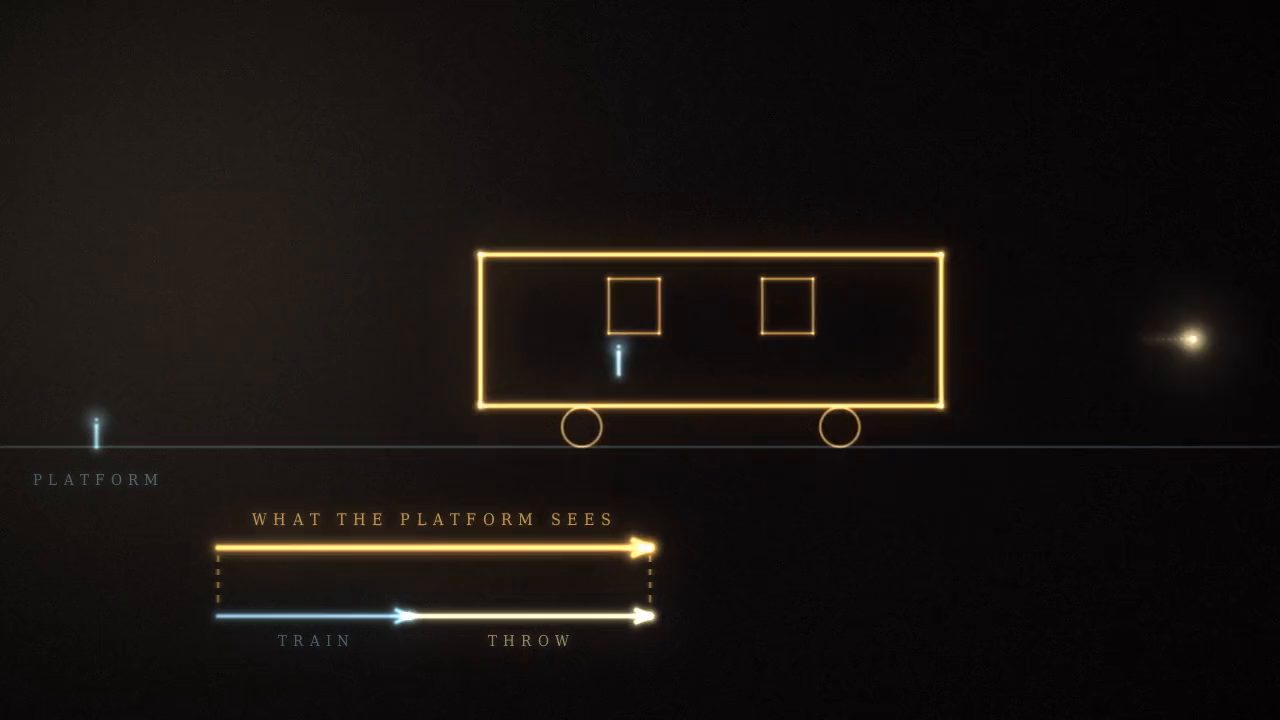
A student on a moving train tosses a ball straight up and catches it. Watch the same toss from inside the train and from the platform. Same ball, same toss, same second of time — two completely different paths.
THE STUDENT ON THE TRAIN MEASURES8.0 ftStraight up, straight down, back into the same hands.
THE PERSON ON THE PLATFORM MEASURES66.4 ftA long arc, because the train carried the ball 66.0 ft down the track while it was in the air.
So which one is the real path?
Both. That is the honest answer and it is the whole point. The student on the train is not confused and the person on the platform is not confused. They agree completely about what happened — the ball left a hand and came back to it. They disagree about how far it travelled, because “how far” is a question you can only answer from somewhere.
Notice something else. The student on the train did not have to throw the ball forward to catch it. It came straight back down into their hands, exactly like it would standing in your kitchen. Inside a smoothly moving vehicle, ordinary experiments behave in ordinary ways. Galileo worked that out four hundred years ago, and it is why you can drink from a water bottle on a plane going 550 miles an hour.
From the film: the platform adds the train's motion to the throw. For a ball, the two speeds simply add together. Hold on to that — it is the thing that is about to break.
THE ONE THING THAT WILL NOT BUDGE
Speeds add. Light does not.
Everything you have ever thrown adds up. Throw a ball at 20 mph on a train doing 45, and the platform clocks it at 65. That is how the whole world works, and you have never once seen it fail.
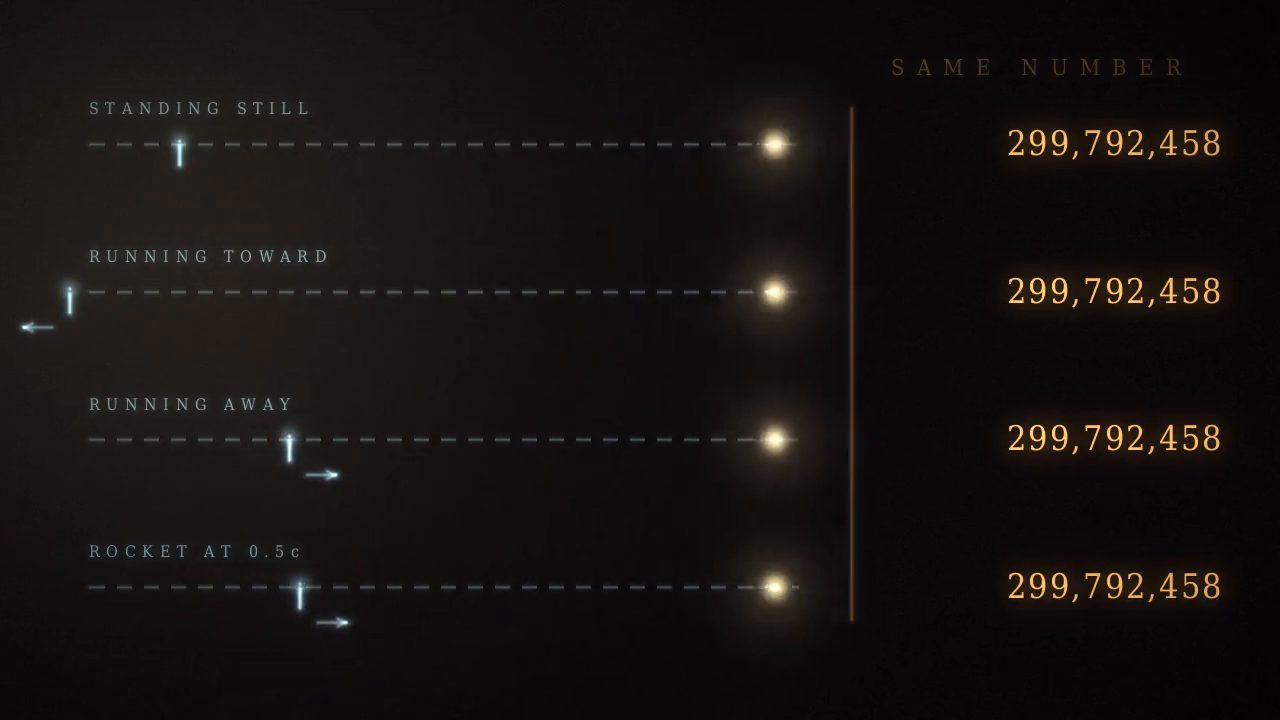
Then somebody measured light. Stand still and measure it: 299,792,458 metres per second. Run toward the light and measure again: the same number. Run away from it: the same number. Chase it in a rocket at half the speed of light: the same number.
Not close to the same. The same. Nobody has ever measured anything else, not once, in a hundred and forty years of people trying very hard to.
WHY THAT ONE FACT BREAKS EVERYTHING ELSE
If the speed cannot change, something else has to.
Four observers. Four completely different states of motion. One number, four times.
Follow the arithmetic you already know.
Speed is distance divided by time. You have used that since middle school. Now look at what it means here.
If the speed cannot change, and the distance changes, then time has to.
That is not a trick and it is not philosophy. It is the only door left. Everybody must measure light at the same speed. So when two observers disagree about how far the light travelled — and you have already seen them disagree about how far a ball travelled — the only thing left that can absorb the difference is the clock.
INTERACTIVE 03 • THE LIGHT CLOCK
Build a clock out of light. Then take it for a ride.
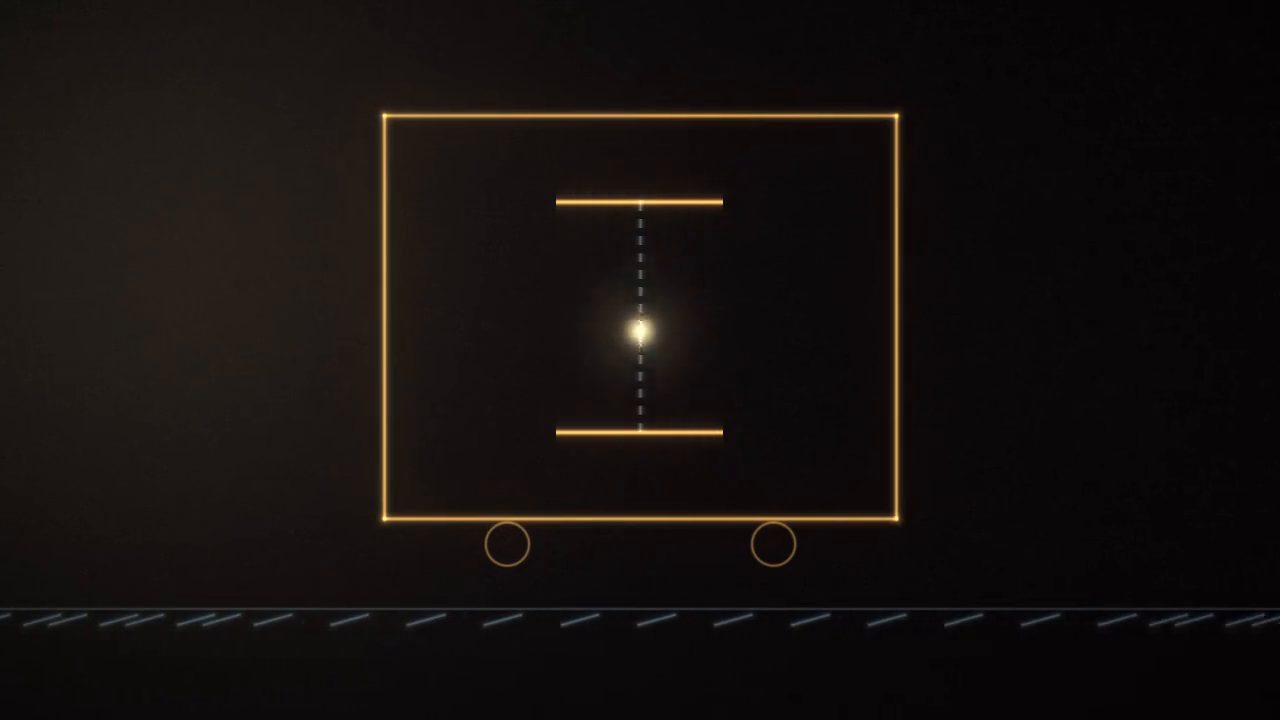
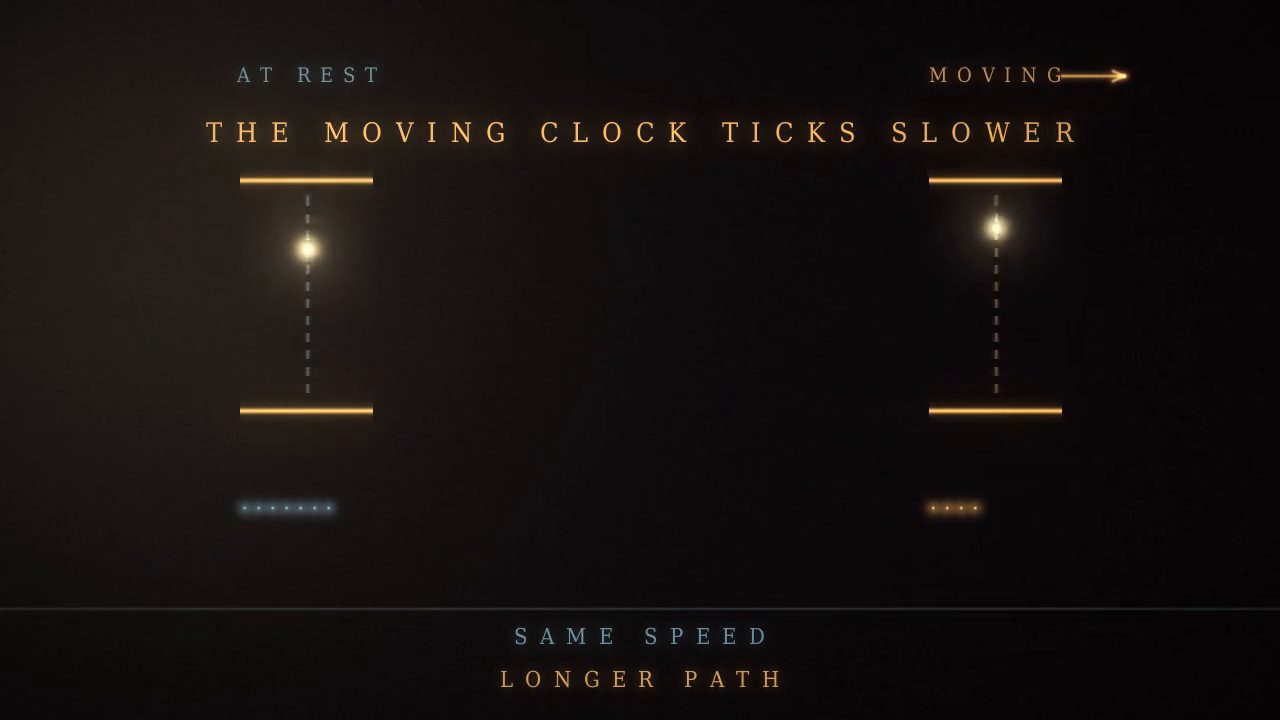
Two mirrors facing each other. One pulse of light bouncing between them. Up, and back down — that is one tick. It is a real clock and it keeps perfect time. Now slide the speed up and watch what the platform sees.
THE MOVING CLOCK RUNS AT60.0%
STRETCH FACTOR (GAMMA)1.667
ONE YEAR AT THIS SPEED PUTS IT BEHIND BY146 days
SAY IT OUT LOUD BEFORE YOU MOVE ON
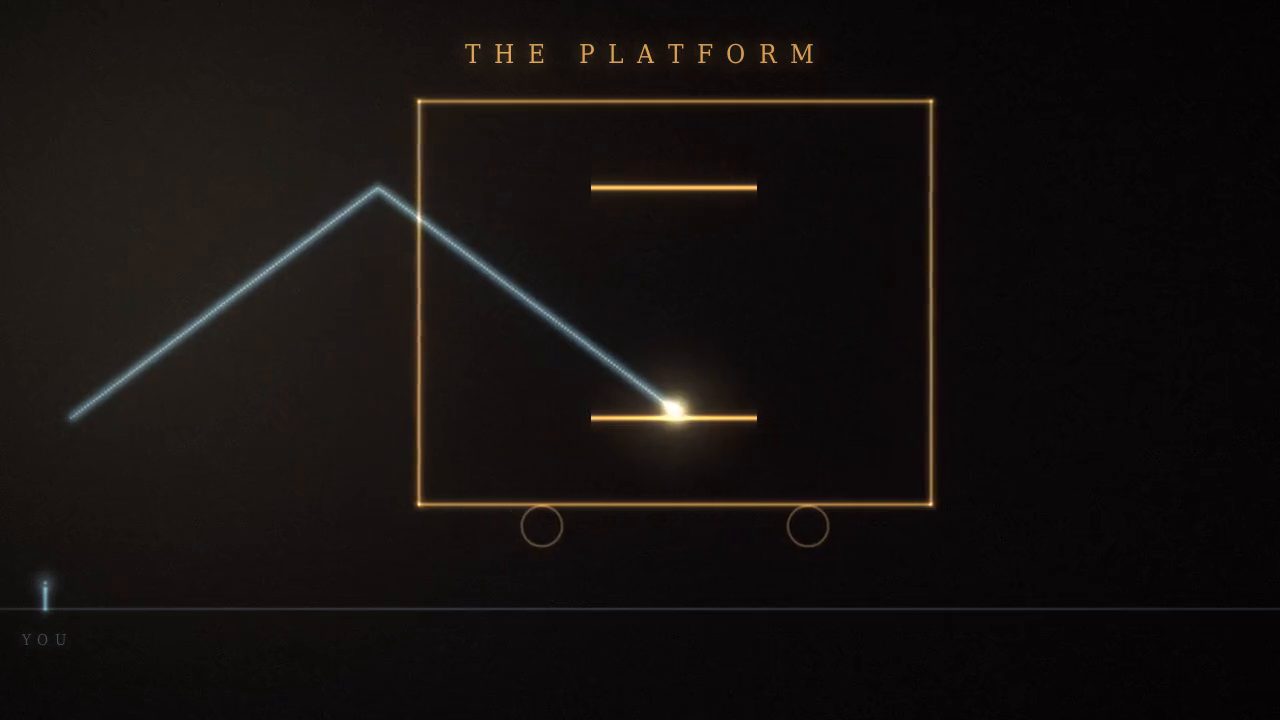
The platform does not see the light go faster. It cannot. So a longer path at the same speed can only mean one thing: more time went by between ticks. The moving clock is running slow. Not looking slow — running slow.
What the rider sees. Straight up. Straight down. One tick.What the platform sees. The clock slid sideways while the light was in flight, so the light went diagonally — and a diagonal is longer than a straight up.
AND IT IS NOT JUST THAT CLOCK
Put a wristwatch beside it. Put a heartbeat beside it.
You might want to say: fine, the light clock runs slow, but that is just a weird clock. It is not.
Set an ordinary wristwatch next to the light clock on that train. If the wristwatch kept normal time while the light clock ran slow, the two would drift apart — and the rider could look at the gap and announce “I must be the one who is moving.” But there is no such thing as being the one who is moving. Motion is only ever relative to something else. That was the whole first half of this lesson.
So the wristwatch has to slow down too. And the heartbeat. And how fast your fingernails grow, and how fast you think, and how fast a sandwich goes stale. All of it, by exactly the same amount. Not the clocks. Time itself, along that path.
The traveller feels nothing. Inside the ship, one second still feels like one second. The difference only shows up when two travellers compare.
Same speed. Longer path. The moving clock ticks slower — and everything travelling with it ticks slower by the same factor.
ARGUMENTS ARE CHEAP
Here is the evidence.
Everything above is a chain of reasoning, and reasoning can be beautiful and still be wrong. So people went and checked. Three times, three completely different ways.
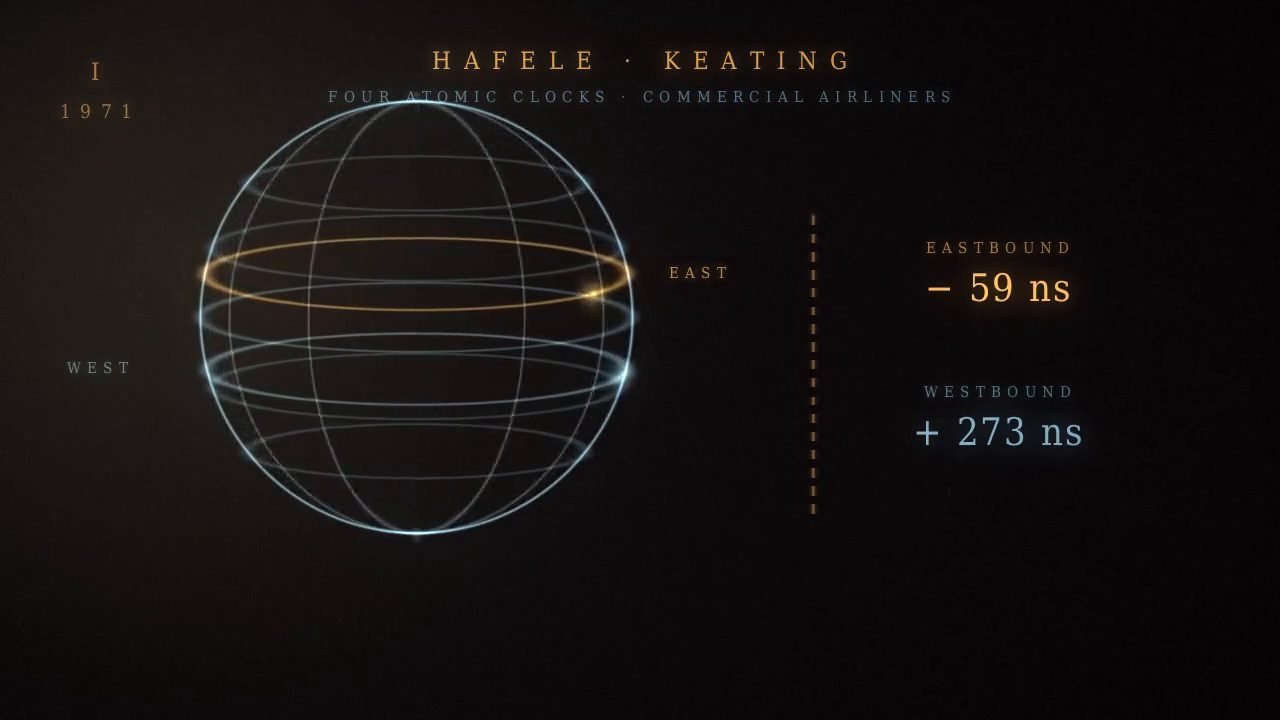
They put clocks on airplanes
1971. Two physicists bought regular seats on regular commercial flights and carried four atomic clocks around the world — once going east, once going west. The eastbound clocks came home 59 nanoseconds slow. The westbound came home 273 nanoseconds fast. Both within a few nanoseconds of what the math predicted before anybody boarded.
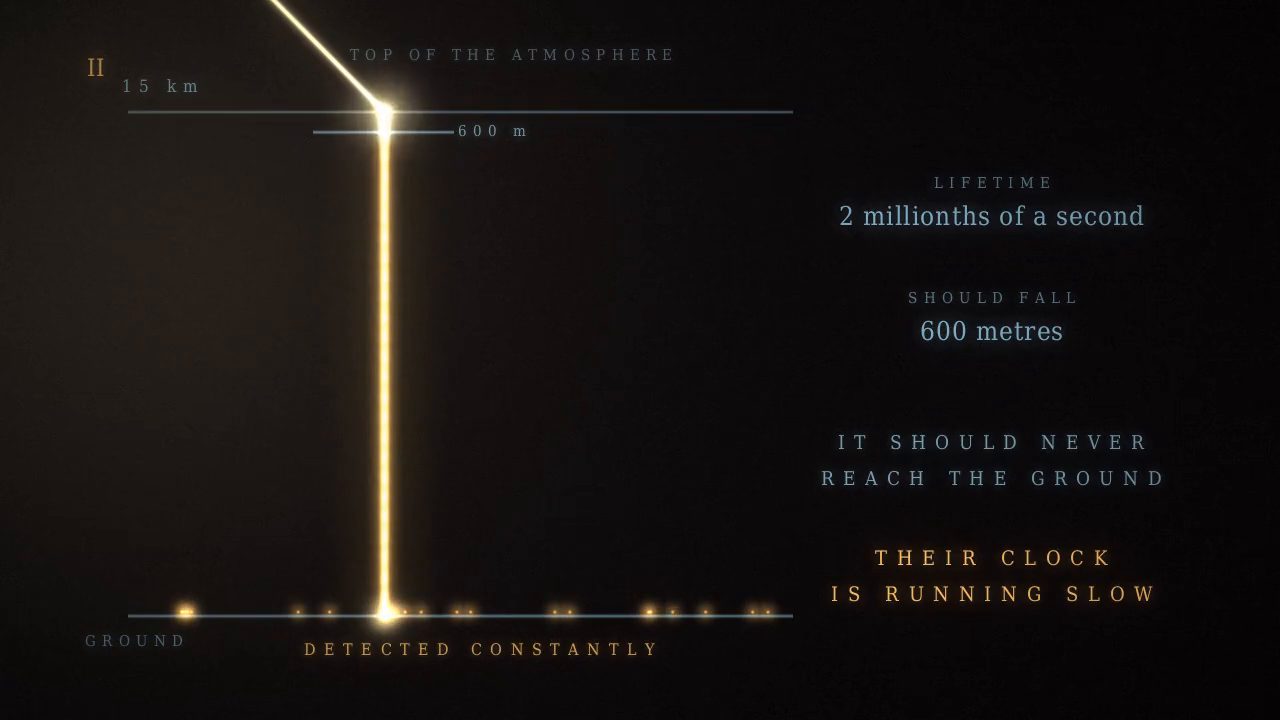
Particles that should never reach the ground
Cosmic rays hit the top of the atmosphere about 15 kilometres up and make particles called muons. A muon lives about two millionths of a second and then falls apart. Even at nearly light speed that is only enough time to fall about 600 metres. It should never get here. We detect them at the ground constantly — because they are moving so fast that their clock is running slow.
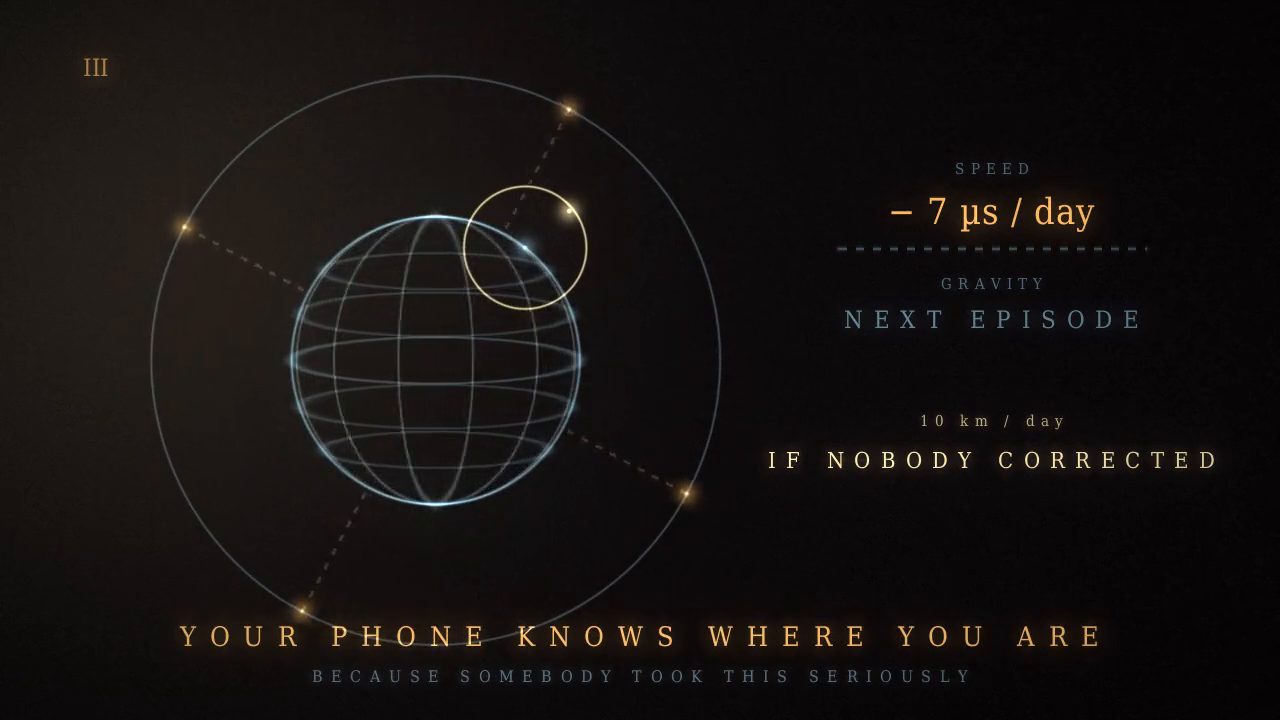
The one in your pocket
GPS satellites orbit 20,000 km up at about 14,000 km/h. That speed alone makes their clocks lose 7 microseconds a day. Gravity does something else to them on top of that — that is the next film. If nobody corrected for it, your phone would put you in the wrong place by about 10 kilometres every day.
WHY THIS IS NOT A PARLOUR TRICK
Six places relativity is already doing a job.
NAVIGATION
Your phone knows where you are
Every map app on Earth depends on satellite clocks that are corrected for both their speed and their height. Engineers did not add those corrections because the theory was pretty. They added them because without them the system does not work.
IF THE CORRECTIONS HAD BEEN SWITCHED OFF WHEN THIS PAGE LOADED, YOUR POSITION WOULD NOW BE WRONG BY0.0 metres
MEDICINE
Particles that live long enough to be useful
Hospitals make short-lived radioactive tracers in accelerators and use them for PET scans and cancer treatment. Accelerated to near light speed, unstable particles last far longer in the laboratory than they do at rest — the same effect that lets muons reach the ground. Machine designers calculate it to the decimal.
ASTRONOMY
Telescopes are time machines
Because light takes time to arrive, looking farther out is looking farther back. Point a big enough telescope deep enough and you are watching galaxies as they were billions of years ago. That is the only reason we can study how the universe changed — we can still see the earlier chapters.
CHEMISTRY AND ENERGY
Where the Sun's energy comes from
E = mc² falls out of the same reasoning: mass is energy in a very concentrated form. When four hydrogen nuclei fuse into helium in the Sun, the helium weighs slightly less than the hydrogen did. That missing mass is the sunlight on your face. The same accounting explains nuclear power and why a nuclear reaction releases millions of times more energy than a chemical one.
TIMEKEEPING
The clocks that run everything else
Atomic clocks in different countries, at different altitudes, tick at measurably different rates — a clock one foot higher on a shelf runs measurably faster. World time has to be assembled from all of them with relativity built into the arithmetic. Banking, the power grid, and the internet all sit on top of that.
SPACE TRAVEL
The twin who comes home younger
Send one twin out at near light speed and bring them back and less time will have passed for them. That is not a movie invention. Astronauts on the space station come home a tiny fraction of a second younger than they would have been — the effect is real, just small at 17,000 mph. It becomes enormous only when you get close to c.
FOUR THINGS RELATIVITY DOES NOT SAY
Getting this wrong is easy. Here is where people slip.
Open each one and check yourself before the exit ticket. If you can explain why the quoted sentence is wrong, you have got the lesson.
Relativity means everything is just an opinion.
No. Observers in different frames measure different numbers, but the differences are not free-for-all — they follow exact rules, and every observer can predict what every other observer will measure. Relativity is one of the most precise theories we have. It is the opposite of “anything goes.”
Time dilation is an illusion. The clocks only look slow.
No. The clocks that flew around the world in 1971 landed genuinely disagreeing with the clock that stayed home, and stayed disagreeing after they were sitting on the same table. Muons genuinely arrive at the ground. This is measured, not perceived.
Nothing can ever travel faster than light.
Almost. The careful version is that no object with mass can be accelerated through the speed of light, and no usable information can outrun light. Those are the rules that actually get tested. A shadow or a laser spot swept across the Moon can move faster than c, because it is not a thing and carries no message.
The bowling-ball-on-a-trampoline picture is how gravity works.
It is a drawing, not the thing. It is useful and we will use it. But notice it cheats — it uses gravity to explain gravity, and it shows two dimensions of a four-dimensional situation. Every model is a window, not the whole world. Say that out loud whenever you use one.
CHECK YOUR UNDERSTANDING
Five questions. No looking back up.
TALK ABOUT IT
Questions worth slowing down for.
01
If the Sun went out this instant, when would we first know? What else would arrive at exactly that moment, and what would happen to Earth's orbit at that moment?
02
Which measurement of the tossed ball is the real one — the rider's or the platform's? Defend your answer in two sentences without using the word “both.”
03
The old light from Earth's dinosaur years really is out there. Explain why that still does not mean anyone could watch a dinosaur.
04
If there is no single universal “now,” what do we actually mean when we say two things happened “at the same time” in ordinary life?
05
What made this science instead of an interesting story? Point at the exact step where it stopped being an argument.
THE LAST WORD
Follow the measurement. All the way.
Nobody decided time ought to work this way because it was beautiful. It is not beautiful and it does not feel right. What happened is that somebody noticed one stubborn fact that would not go away — the speed of light will not change, no matter what you do — and then they were honest about where that fact led, even when it led somewhere ridiculous. That is the actual job. Not being clever. Being willing to follow the thing you measured to the place it goes, when everything in you wants to stop.
The universe is under no obligation to make sense to you. It only has to be consistent. And it is.
Purpose. Students follow one story from ordinary motion to the edge of a beam of light. By the end they should understand that relativity does not mean “anything can be true.” It means measurements of time, distance and motion depend on the observer's frame of reference, while the speed of light stays put.
Learning targets. I can explain what a frame of reference is. I can describe in words why moving clocks measure time differently. I can tell special relativity from general relativity. I can give one real-world example of relativity at work.
Materials. Projector; two chairs; a flashlight or phone light; one ball. No calculator.
ACCURACY NOTE — SAY THIS PLAINLY
The train, the flashlight and the stretched fabric are teaching models. They help students picture the ideas. They are not complete pictures of spacetime. Say so out loud so the analogy never replaces the science.
0–5 MIN
The night sky is a history book
“Step outside tonight and look at the Moon. It looks immediate. But the light hitting your eye left the Moon about 1.3 seconds ago. Look at the Sun and you are eight minutes behind. Look at a distant star and the light may have started before any of us were born. The sky is not simply above us. It is behind us in time.”
SHOWInteractive 01 on the board. Write: Moon ≈ 1.3 s • Sun ≈ 8.3 min • nearest star ≈ 4.24 yr.
ASKIf the Sun disappeared this instant, how long would we keep receiving its light? Let them predict, then confirm: about eight minutes.
5–10 MIN
Motion needs a point of view
“Two students ride smoothly inside a train. One tosses a ball straight up. To the student on the train, the ball rises and falls into the same hands. A person beside the track sees it go up, forward, and down. Neither one is lying. Neither one has broken eyes. They are describing the same event from different frames of reference.”
DOHave a student walk slowly across the room tossing a ball gently upward. Ask the class to describe the path from the walker's point of view and from the room's.
SHOWInteractive 02, speed slider at 45 mph. Read both numbers aloud.
STOP AND SAYRelativity does not mean facts disappear. It means motion has to be described relative to a frame.
10–18 MIN
Chasing a beam of light
“When Einstein was young he wondered what it would be like to chase a beam of light. Drive beside a car at the same speed and the other car looks almost still. Does light do that? Experiments say no. However fast you move, light in empty space measures the same: about 300,000 kilometres every second. If everyone must measure the same speed of light, then time and distance cannot stay the same for everyone.”
SHOWPlay the film from the start through the four-lane sequence, or scroll to the four-lane still.
ASKIf a spaceship flies toward a beam of light, will the crew measure it as slower? Make them commit before you answer. No.
18–27 MIN
The light clock — the centrepiece
“Two mirrors, one above the other. A flash of light bounces between them. Each round trip is one tick. In a motionless train the light goes straight up and straight down. Now the train rushes past the station. The person on the platform sees the train move forward while the light is travelling, so from there the light follows a longer diagonal. But both observers must measure light at the same speed. A longer path at the same speed means more time between ticks. The moving clock runs more slowly.”
SHOWInteractive 03. Start at 0, walk the slider up, let them watch the tick counters separate.
TURN AND TALKWhy can't the outside observer just say the light moved faster? Expected: because the speed of light is the thing that cannot change, so the difference has to land in the time.
EXTENDPut a wristwatch and a heartbeat beside it. If they did not slow too, the rider could detect their own motion — and there is no such thing.
27–33 MIN
Would you really age more slowly?
“One twin stays on Earth. The other travels near light speed and comes back younger, because less time passed along that path. This is not eyesight. Clocks on fast aircraft and satellites really do disagree with clocks on the ground. At school-bus speed the difference is far too small to notice. Near light speed it becomes dramatic. Nature is not keeping one giant clock for the universe. Each traveller carries time along their own path.”
QUICK CHECKDoes the traveller feel time slowing inside the ship? No. Their watch, heartbeat and thoughts all feel normal. The difference only appears when observers compare.
33–39 MIN
Gravity changes the shape of the story
“Special relativity deals with steady motion. Einstein then asked a bigger question: what is gravity? Newton called it an attraction between masses. Einstein said something deeper — mass and energy change the geometry of spacetime, and Earth follows that shape around the Sun the way a car follows the shape of a road.”
SHOWHeavy ball on stretched fabric if you have it. Then name the limit out loud: the cloth is only a picture. Real spacetime is three dimensions of space plus time, and it does not need a downward gravity to bend.
ASKWhich bends spacetime more, a marble or a star? Why? The star — far more mass-energy.
NAME THE DIFFERENCESpecial relativity: constant motion, especially near light speed. General relativity: gravity, acceleration, curved spacetime. That is next episode.
39–43 MIN
Relativity in your pocket
SHOWThe implications section. Read the live GPS drift counter off the board — it has been climbing the whole class.
ASKName one earlier idea GPS proves has a real effect: moving clocks differ, gravity affects time, or both. Answer: both.
FOR CHEMISTRY AND IPCSpend the extra minute on E = mc²: the helium is lighter than the hydrogen that made it, and the missing mass is the sunlight. That is the bridge from today into everything we do with energy this year.
43–45 MIN
Bring the travellers home
“We began under a sky full of old light. We boarded a train where motion looked different from two places. We chased a beam of light and found that time itself had to give. Relativity does not say the universe makes no sense. It says the universe is more carefully connected than ordinary experience first reveals.”
EXIT TICKETThree questions, below. Students finish before they leave.
Exit ticket
What is a frame of reference? Give one example.
Why does the outside observer say the moving light clock runs slowly?
Name one difference between special relativity and general relativity.
Answer guide
The point of view, or coordinate system, that motion is measured from. Example: a passenger inside a train versus a person beside the track.
The platform sees the light travel a longer diagonal path. Because the speed of light cannot change, more time must pass between ticks.
Special relativity is about constant relative motion and light. General relativity explains gravity as curved spacetime and includes acceleration.
Misconceptions to catch
“Relativity means everything is an opinion.” No — observers measure differently, but the differences follow precise laws.
“Time dilation is only an illusion.” No — real clocks and real particles show measurable differences.
“Nothing can travel faster than light.” The precise rule: matter cannot be accelerated through c, and usable information cannot outrun light.
“The fabric model is how gravity really works.” No — it is a limited visualisation of curvature.
If time remains
Ask whether a person falling freely inside a closed elevator could tell, for a brief moment, whether they were falling or floating in space. Use the answers to introduce the equivalence principle: locally, free fall and weightlessness look the same. That is the doorway into the next lesson.
Where this sits in the standards
Scientific and engineering practices — developing and using models, analysing and interpreting data, constructing explanations from evidence, and distinguishing a model from the thing it models. The historical-evidence discussion also serves the nature-of-science strand: how a claim becomes a measurement.