
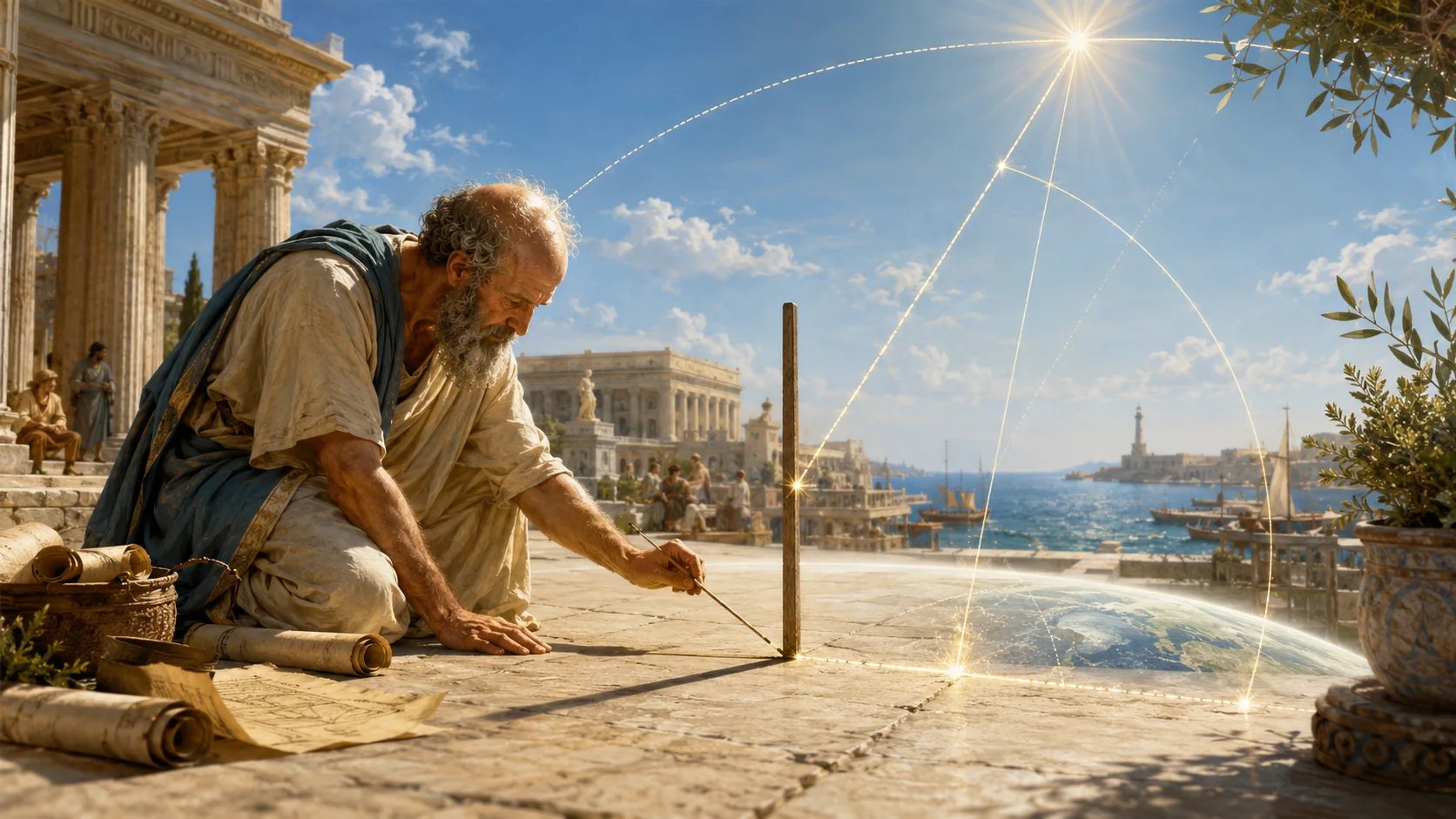
A true story of scientific ingenuity
The man who measured Earth with a shadow.
No satellites. No airplanes. No journey around the world. More than 2,200 years ago, Eratosthenes used a stick, a shadow, and a daring idea to calculate the size of our planet.
Imagine being asked to measure the entire Earth.
You cannot fly above it. You cannot circle it in a ship. You do not have a telescope, a calculator, or even an accurate map of the whole world. You have sunlight, a straight stick, and your own mind.
Most people would call the task impossible. Eratosthenes saw a geometry problem waiting to be solved.
The clue
A city with no shadow
Eratosthenes lived in Alexandria, Egypt, where he directed the great library. He learned of something strange that happened far to the south, in the city of Syene.
At noon on the summer solstice, sunlight shone straight down into a deep well. Upright objects cast almost no shadow. The Sun appeared directly overhead.
But at that same moment in Alexandria, an upright stick did cast a shadow.
The brilliant leap
The shadow was evidence.
Eratosthenes understood that the Sun was extremely far away, so its rays reached Earth almost parallel to one another. If Earth were flat, sticks in both cities should cast the same kind of shadow.
They did not. The ground beneath the sticks was tilted in different directions because Earth's surface was curved.
The small angle of one shadow revealed a small piece of the planet's entire curve.
The experiment
From one angle to a whole world
Measure the shadow
At noon on the solstice, Eratosthenes measured the shadow of a vertical object in Alexandria.
Find the angle
The Sun's rays and the object formed an angle of about 7.2°.
Recognize the fraction
Because 7.2 is one-fiftieth of 360, the distance between the cities represented about 1/50 of Earth's circumference.
Scale it up
Multiply the distance from Alexandria to Syene by 50, and the circumference of the entire planet appears.
INTERACTIVE RECONSTRUCTION
Move the shadow.
Measure the world.
Change the observations and watch every part of the argument respond. Then step through the geometry until the calculation becomes visible.
Start with parallel sunlight reaching both cities at the same moment.
WATCH THE REASONING UNFOLD
One shadow.
One whole world.
This visual reconstruction follows the same four steps as the interactive model: observe, measure, recognize the fraction, and scale it to the planet.
Why it still matters
He did not see the whole Earth. He followed the evidence.
Eratosthenes's calculation gave approximately 250,000 stadia. The exact length of the ancient stadion he used is uncertain, so no single modern conversion can be proved. For a clear classroom comparison, historians and geodesy texts sometimes use a convenient estimate of one stadion as about one-tenth of a mile. With that conversion, 250,000 stadia becomes about 25,000 miles.
Earth's actual circumference around the equator is approximately 24,901 miles. On that classroom conversion, Eratosthenes's result differs by only about 99 miles—an error of roughly 0.4 percent. Other proposed lengths for the stadion produce different totals, which is why historians describe his exact accuracy cautiously.
What is not uncertain is the achievement: Eratosthenes produced a powerful estimate using observation, measurement, a model, and mathematics.
That is science at its most powerful. A huge question can sometimes be answered by noticing one small thing that everyone else walks past.
Your turn to wonder
What could your shadow tell you?
Why does your shadow change length during the day?
Could two schools in different cities repeat Eratosthenes's experiment?
What measurements would have to be precise—and what sources of error might appear?
The next great discovery may begin with something ordinary—and someone curious enough to ask why.
Explore more science →