
One object. One dot.
Each photon or electron is detected at a single place. The hit is particle-like.
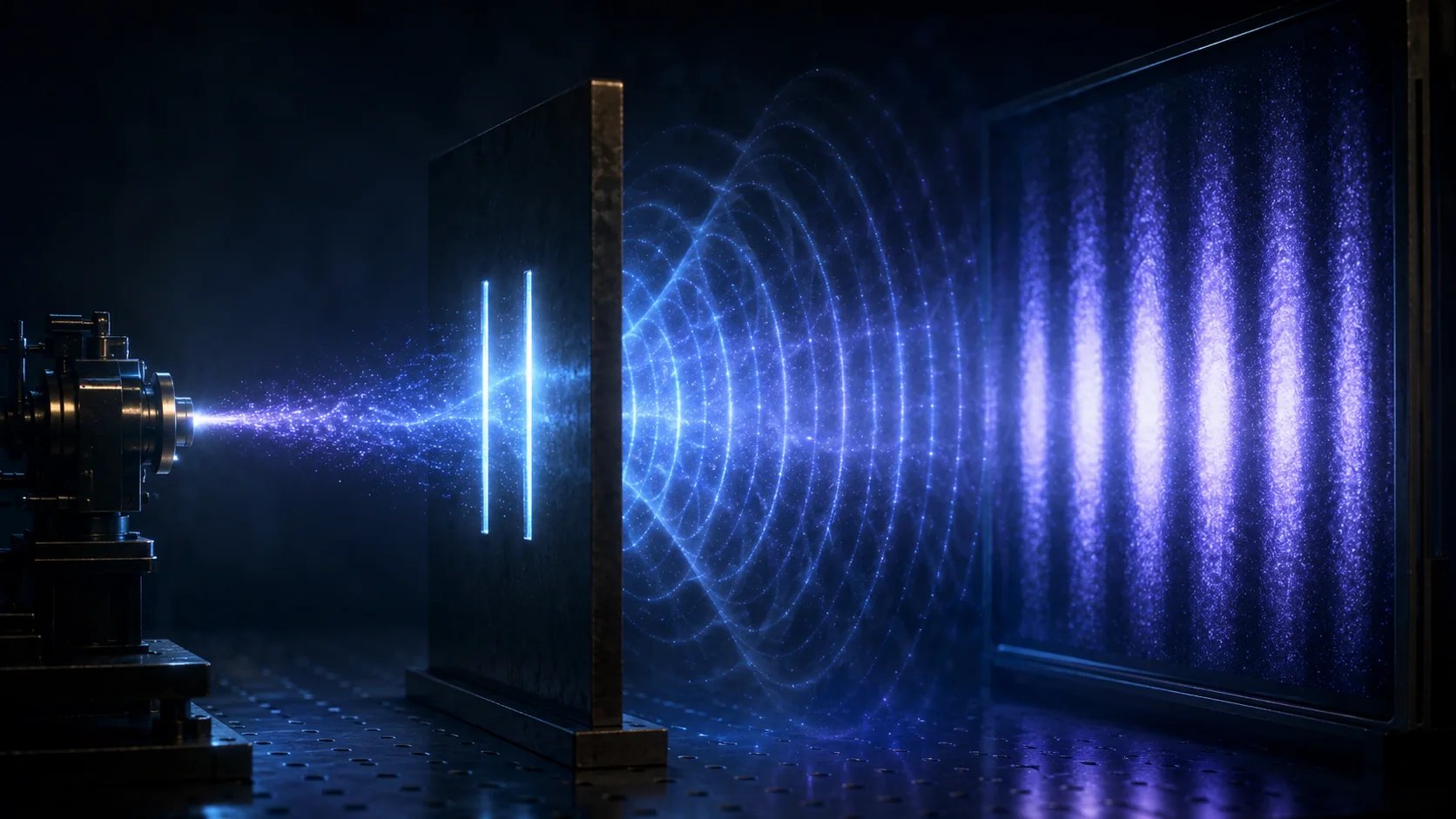
THE EXPERIMENT THAT REFUSED TO ACT NORMAL
It reaches a wall with two narrow openings. It lands as one small dot. Nothing unusual—until the dots begin to pile up and reveal a pattern no ordinary particle should be able to make.
Watch the impossible pattern appear →FIRST, THE SIMPLE VERSION
Imagine a machine that fires tiny marbles toward a barrier. The barrier has two narrow slits. Behind it stands a screen that records every hit.
If marbles pass through the openings, you expect two piles on the screen—one behind each slit. That is sensible. That is ordinary. That is exactly what little solid objects should do.
Now replace the marbles with light particles called photons, or with electrons. Turn the power down until they travel through the experiment one at a time.
Then watch common sense leave the room.WHAT A PARTICLE SHOULD DO
A classical particle follows one path, passes through one opening, and lands somewhere behind it.
WAVES DO SOMETHING DIFFERENT
Send water waves through two openings and each slit becomes the center of a new ripple. Where two crests meet, they build a stronger wave. Where a crest meets a trough, they cancel.
On a screen, that creates many alternating bright and dark bands. Physicists call it an interference pattern.
NOW FIRE THE PARTICLES ONE AT A TIME
The first electron arrives: one dot. The next arrives: another dot. There is never half an electron smeared across the screen. Every detection is a single, definite hit.
But after hundreds and thousands arrive, the dots do not form two ordinary piles. They slowly build many bands—the interference pattern of a wave passing through both slits.
One particle at a time. No other particle beside it to interfere with. Yet the full pattern still appears.
THE QUESTION THAT SHOOK PHYSICS
The electron arrives at one place like a particle. Its possible paths combine like waves. Quantum physics does not say it was secretly a tiny marble following an ordinary route that we simply failed to notice. Before the path is measured, the experiment must be described using a spread of possibilities called a quantum state.
Those possibilities can interfere. Some landing places become more likely. Others become less likely. The bright and dark bands map those probabilities.
SO WE TRY TO CATCH IT
Scientists can arrange equipment to reveal which path the particle took. It sounds like the obvious way to solve the mystery.
When the setup can determine which slit the particle used, the interference pattern is lost. The screen now shows the particle-like result instead of the many wave-like bands.
This is not because a human eye stared at it. A conscious person is not magical. The measuring equipment physically interacts with the quantum system, and the path information destroys the delicate combination of possibilities that produced interference.
IMPORTANT: WHAT THIS DOES NOT MEAN
WHAT THE EXPERIMENT FORCES US TO ACCEPT
Each photon or electron is detected at a single place. The hit is particle-like.
The final distribution contains bright and dark bands, like waves overlapping.
When which-path information exists, the interference disappears.
THIS IS NOT JUST A WEIRD STORY
Quantum behavior helps explain atoms, chemical bonds, lasers, computer chips, solar cells, and medical imaging. Chemistry works because electrons in atoms do not follow miniature planet-like paths. Their allowed states and probabilities shape the periodic table and every bond between atoms.
The double slit experiment matters because it puts the central mystery in plain view. Nature gives us definite events—one flash, one dot, one measurement—but the probabilities leading to those events behave in a wave-like way.
TALK ABOUT IT
Why would ordinary marbles make two bands instead of an interference pattern?
What is strange about building a wave pattern one particle at a time?
Why is “measurement” more accurate than saying “a person looked at it”?
Can a result be difficult to imagine and still be supported by strong evidence?
THE LAST DOT
The double slit experiment does not give us a comfortable picture of what happens between the source and the screen. It gives us something better: a result we can test again and again. The dots are real. The pattern is real. The change caused by which-path measurement is real.
Sometimes science makes the world easier to understand. Sometimes it shows us that reality has been stranger all along.
Return to today's lesson plan →